Note: For an optimal reading experience, please ensure your browser is rendering the page at 100% zoom ("Cmd/Ctrl +/-").
Ibsen and the Kammerspielfilm
Thor Holt
“The masses want romance—and the cinema provides it. Theaters should watch out: they have never faced such intense competition as they are now, and they will start to notice it more and more in their ticket sales,” warned actor and writer Hanns Heinz Ewers shortly before co-scripting Der Student von Prag (The Student of Prague) in 1913. He went on to predict that “today, the galleries are already emptying out and soon the main floors will start emptying too. Theatergoers will be left to watch Don Carlos or Ibsen by themselves. The masses abandon them and run to the movies.”[1] While Ewers correctly foresaw the immense appeal of the new medium, he failed to anticipate how Ibsen would catch up with the popular taste and become a cornerstone of German silent cinema. Ibsen was one of the most adapted writers in the Weimar era and filmmakers often drew on his dramas in subtle ways.
This article explores how Ibsen’s dramas inspired and shaped the Kammerspielfilm, the most ambitious attempt to bridge the gap between theater and cinema, high and low arts, in the Weimar Republic. The central argument is that the relation between Ibsen and these films must be understood as a complex web of translations, performances, sketches, and films building on Ibsen in various ways. What is at stake, in other words, is not only adaptation in the traditional sense as a transfer of whole works from one medium to another, but a broader intermediality of overlapping cultural expressions that helped shape this distinctive film genre, of which Ibsen is one influence among many.[2] The article’s larger concern is historical, situating the Kammerspielfilm in a new international and intermedial context.
Retrospective discussions of the Kammerspielfilm tend to limit the genre to a few psychological dramas written by the Austrian screenwriter Carl Mayer. These include Lupu Pick’s Scherben (Shattered, 1921) and Sylvester (New Year’s Eve, 1923), Leopold Jessner’s Hintertreppe (Backstairs, 1921), and F. W. Murnau’s Der letzte Mann (The Last Laugh, 1924). This article expands the genre’s canon by incorporating two films that tend to be overlooked: Murnau’s Der Gang in die Nacht (Journey into the Night, 1921) invokes Ibsen and was promoted as the very first Kammerspielfilm, while Pick’s Das Haus der Lüge (The House of Lies, 1926), a traditional adaptation of Ibsen’s Vildanden (The Wild Duck, 1884), completes the director’s trilogy of Kammerspielfilme and reads as a swansong to the genre.
There are several key similarities in the characteristics of Ibsenian drama and the German Kammerspielfilm. Ibsen’s major contribution to theater was a condensed chamber drama centered on the gradual unveiling of a suppressed past. This expositional structure demanded naturalistic acting techniques, which soon followed.[3] The Norwegian literary historian Per Thomas Andersen emphasizes that Ibsenian drama “reduces the number of characters…who are tied together in close relationships. The scenes are compiled according to an absolutely necessary logic of action. No threads are loose or accidental, and the entire play unfolds within a short time span.”[4] These literary and theatrical innovations anticipate the Kammerspielfilm in notable ways. This is apparent in film historian David Bordwell’s introduction to the genre.
Kammerspiel films were far more naturalistic than Expressionist films. They concentrate on a very few characters in a drastically limited number of locales. Performance is often slow and understated, though action may freeze into somewhat contorted poses. The action typically takes place in a short time span, and it is built up out of everyday activities in working-class households—chores, job routines, the habits of family life. Eventually, however, the mundane milieu is likely to explode into violence.[5]
Following Bordwell’s definition, the generic logic of the Kammerspielfilm mirrors Ibsen’s social dramas, except for two notable differences: the films lack dialogue and redirect Ibsen’s renowned dissection of the bourgeoisie toward petty-bourgeois or working-class households.[6] In an essay on Scherben, Anton Kaes writes that “these films share with the theatrical Kammerspiel the focus on a small number of characters, their traumatic interaction in a closed space, and the violent resolution of the conflict.”[7] This definition could also be applied to Ibsen. Both Ibsenian drama and the Kammerspielfilm are characterized by a unity of action, time, and place, and the outcomes of the narratives are perceived as inevitable when pressures from the past and the social environment converge upon the characters.
Contemporary critics identified Weimar era Ibsen adaptations as extensions of the Kammerspielfilm genre. Siegfried Kracauer famously discussed Mayer’s chamber dramas as “instinct films” that anticipated “truly cinematic narration” through their focus on objects and rejection of the written word.[8] He argued that these films originated from Robert Wiene’s Das Cabinet des Dr. Caligari (The Cabinet of Dr. Caligari, 1920), which Mayer also scripted, and mentions Pick’s Das Haus der Lüge in a footnote as a film “in a similar vein” to the instinct films.[9] Critic and screenwriter Willy Haas listed Pick’s Ibsen adaptation as a Kammerspielfilm and added Berthold Viertel’s 1923 adaptation of Et dukkehjem (A Doll’s House, 1879), titled Nora and shot with two different endings, to his list.[10] Haas, however, disagreed with Kracauer and argued that Richard Oswald’s Aufklärungsfilm—another genre with clear links to Ibsen’s dramas—was the main source of the Kammerspielfilm.
Another critic who omitted to discuss Ibsen’s influence on the genre is Lotte Eisner, who traced the origins of Weimar cinema in general and the Kammerspielfilm in particular back to the legendary theater director Max Reinhardt. Eisner’s omission is notable given Ibsen’s remarkable influence on Reinhardt. Reinhardt launched his career as a stage director with a production of Ibsen’s Kjærlighedens Komedie (Love’s Comedy, 1862) in 1900, and he inaugurated the Kammerspiele at Deutsches Theater in Berlin with a seminal performance of Ibsen’s Gengangere (Ghosts, 1881) in 1906. The Kammerspiele was designed specifically to stage intimate versions of Ibsen’s and Strindberg’s chamber dramas. Although film historians have noted the derivation of the term Kammerspielfilm from the theatrical Kammerspiele, they have not examined Ibsen’s broader role in that lineage.
More recent studies on Weimar cinema offer intriguing insights into how Ibsen’s dramas may have inspired the genre. Thomas Elsaesser, referencing Ibsen and Strindberg, argues that “Murnau’s debt to the Scandinavian masters consisted in his ability to adopt their naturalism and heighten it further in the direction of ordinary actions and simple gestures suffused with an atmosphere at once lyrical and uncanny, ethereal and mysterious.”[11] Elsaesser thus echoes Bordwell’s emphasis on the genre’s naturalistic qualities and highlights the eerie mood which imbues the mundane with sinister undertones. Kaes considers Jessner’s Hintertreppe to be “a ‘chamber play film’ (Kammerspielfilm) in the tradition of an Ibsen play,” and thus highlights more subtle interconnections between Ibsenian drama and Mayer’s carefully scripted film.[12]
Elsaesser and Kaes’ observations seem all the more tenable when one considers that the directors associated with the Kammerspielfilm were deeply familiar with Ibsen. For example, Lupu Pick played the schoolmaster Rørlund in a performance of Ibsen’s Samfundets Støtter (The Pillars of Society, 1877) in Hamburg in 1911. According to Murnau’s brother, Robert Plumpe, the director was well-versed in Ibsen by the age of twelve.[13] Having staged ten of Ibsen’s dramas on German theater stages before transitioning to film with Hintertreppe in 1921, Leopold Jessner was a seasoned Ibsen director. It is also noteworthy that Carl Mayer in the early 1920s was contracted to write a script for an adaptation of A Doll’s House, a project that never materialized for unknown reasons.[14]
It is apparent that Ibsen was a reference point for both directors and critics of the Kammerspielfilm in the 1920s. To better understand how his dramas contributed to the generic formation of these films, it may be worthwhile to shift our focus from his written plays exclusively to “Ibsen” as a cultural text. The following chronological sketch offers initial steps in this investigation.
July 11, 1906: Reinhardt Appoints Munch as Set Designer
When Max Reinhardt worked on Ghosts for the opening of the Kammerspiele in 1906, he turned to the Norwegian painter Edvard Munch for ideas on set design.[15] Munch was intimately familiar with the play’s setting, bleak mood, and alcohol-fueled despair. In Ghosts, the prodigal son Osvald returns from Paris, where he has lived freely and happily as an artist. Unlike his debauched father, the late Captain Alving, Osvald has not led a life of degenerate excess; nevertheless, he has contracted syphilis. Portraying the past catching up with the present, the play suggests a mirror-like reflection between father and son in terms of appearance and a sharp contrast in terms of behavior. Osvald’s infection is an example of the sins of the father being visited upon the child, which, in turn, spirals the household into death or despair within days. Ghosts is considered Ibsen’s most naturalistic drama.
Reinhardt requested a “sketch for the decoration of Ghosts with a window view.”[16] Munch—at that time convalescing in Weimar after a period of heavy drinking in Berlin—answered with a series of mood sketches (Stimmungs-Skizzen) that prefigured the Kammerspielfilm’s characteristic focus on objects, atmosphere, shadows, and Umwelt.
The centerpiece of Munch’s set design for Ghosts features Osvald, his mother Mrs. Alving, and the housemaid Regine standing with heads bowed around a table. A black chair, two portraits on the wall, and a looming grandfather clock in the corner fill the space. In the background is a view of a fjordscape. Munch portrayed all the characters in the drama as culturally decadent, which is suggested in the paintings with their shrouded, doomed figures. To Munch, and Reinhardt after him, Osvald might as well be an alcoholic and diseased man; in the original Ibsen text, however, he lives an alternative ethical life that is not sanctioned by the church or marriage.
This spare and unsettling sketch unlocked the symbolic potential of Ibsen’s stage directions. Munch noted in his journals that “a chair can be just as interesting as a human being,” a sentiment which Reinhardt evidently agreed with, as recorded in the memoirs of his designer, Ernst Stern.[17] Stern told the director that he considered the set design to be nothing but “a typical Munch picture,” offering little indication of how the room should be furnished. Reinhardt replied “maybe, but the heavy armchair tells you all you want to know. The dark coloring reflects the whole atmosphere of the drama.”[18] It was not only the heavy color of the chair that emphasized the objects at the expense of the subjects. Munch depersonalized the characters by erasing their physiognomy and conflating their physicality. Thus, the sketches frame the dramatis personae as victims of a shared fate, predetermined by the continuing force of the ancestors in the portraits on the wall. This unleashed the dark forces of the bourgeois parlor as Reinhardt had imagined—above all “the voluptuousness and the brutality of its dead master,” Captain Alving, the deceased patriarch whose ghost haunts the play.[19]
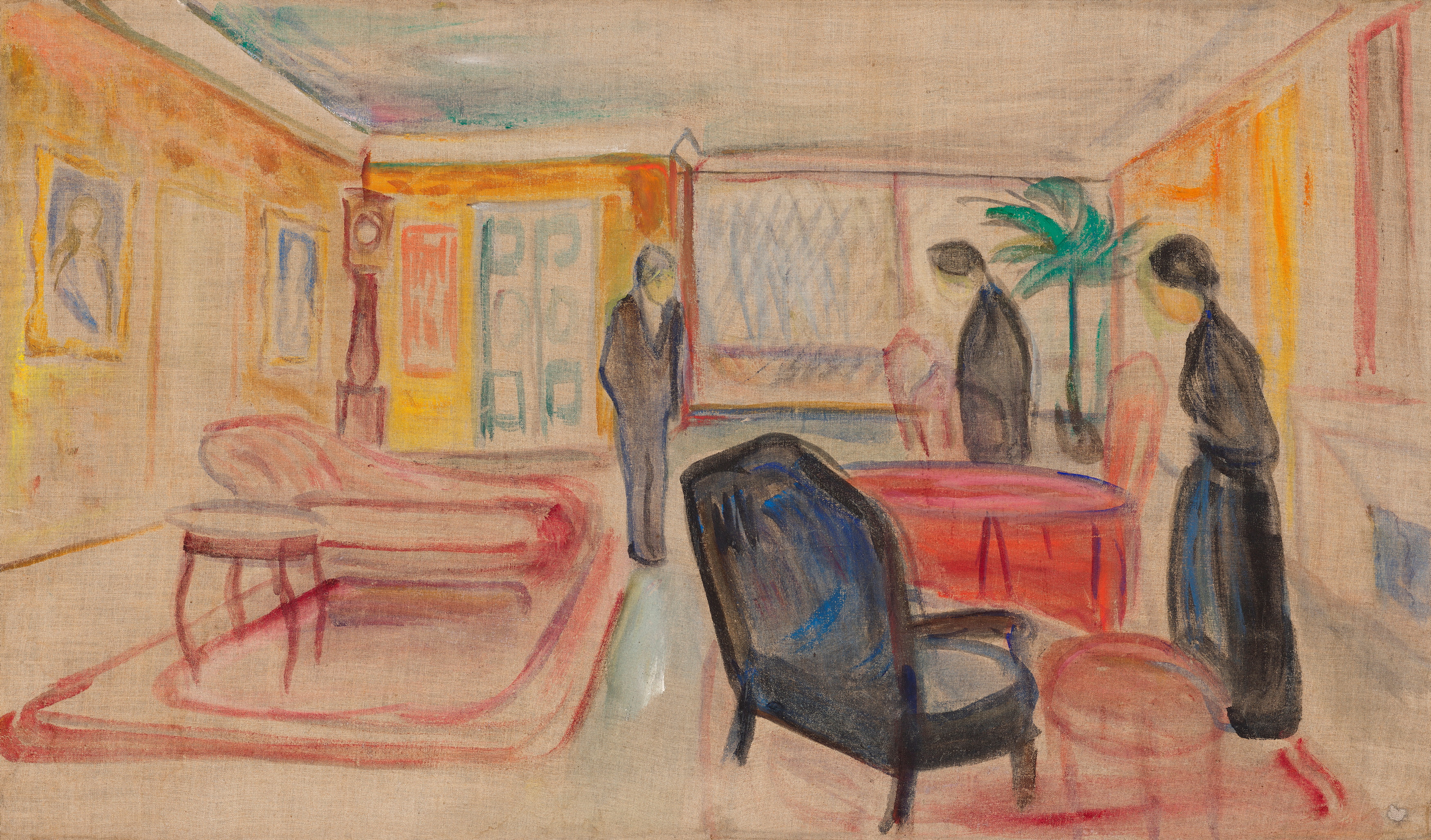
Munch’s set design for Reinhardt’s Ghosts. Courtesy of the Munch Museum.
Munch’s set designs and mood sketches are intermedial composites in their own right, equally in dialogue with Ibsen’s stage directions, Reinhardt’s instructions, Munch’s previous works, and photographs of Norwegian parlors. The paintings made a lasting impression on contemporary viewers. Willy Haas, for instance, recalled “the extremely concentrated atmospheric power of Edvard Munch’s scene pictures for Ghosts” in his commemorative essay on Max Reinhardt fifty years later.[20] Munch emphasized the symbolism of the objects and the expressionism of the shadows. The crucial role of Umwelt was Reinhardt’s conceptual contribution.[21] In Munch’s set design, the black chair and the grandfather clock both function as harbingers of Osvald’s death. Ibsen scholar Joan Templeton aptly remarks that Munch’s mood sketches are “expressionist renderings of powerlessness, hopelessness, and dread.”[22] She further observes that “the play’s characters are not depicted as people in a drama but as figures fixed in a tableau. Their rigid immobility points to their condition as helpless participants in a momentous and terrible fate.”[23] By stripping the play of dialogue, plot lines, and psychological motivation and focusing instead on mood, objects, and arrangement, Munch created a disturbing portrait of a household headed toward an inescapable destiny. In doing so, he anticipated the contorted poses and compulsory dramaturgy of the Kammerspielfilm by visual means.
In another set design, which can be seen as a precursor to the expressionism of Weimar cinema, Munch situates the characters under four looming shadows. Collective destiny, rather than individual motivation, was Munch’s concern in his sketches. Unifying the figures through their black clothing, he seems to indicate that subjective will is inferior to the dark forces of the oversized shadows. Munch’s choice to give them sickly yellow‑green complexions reveals his preference for expressionistically evoking their psychological turmoil rather than naturalistically depicting their physical appearance.
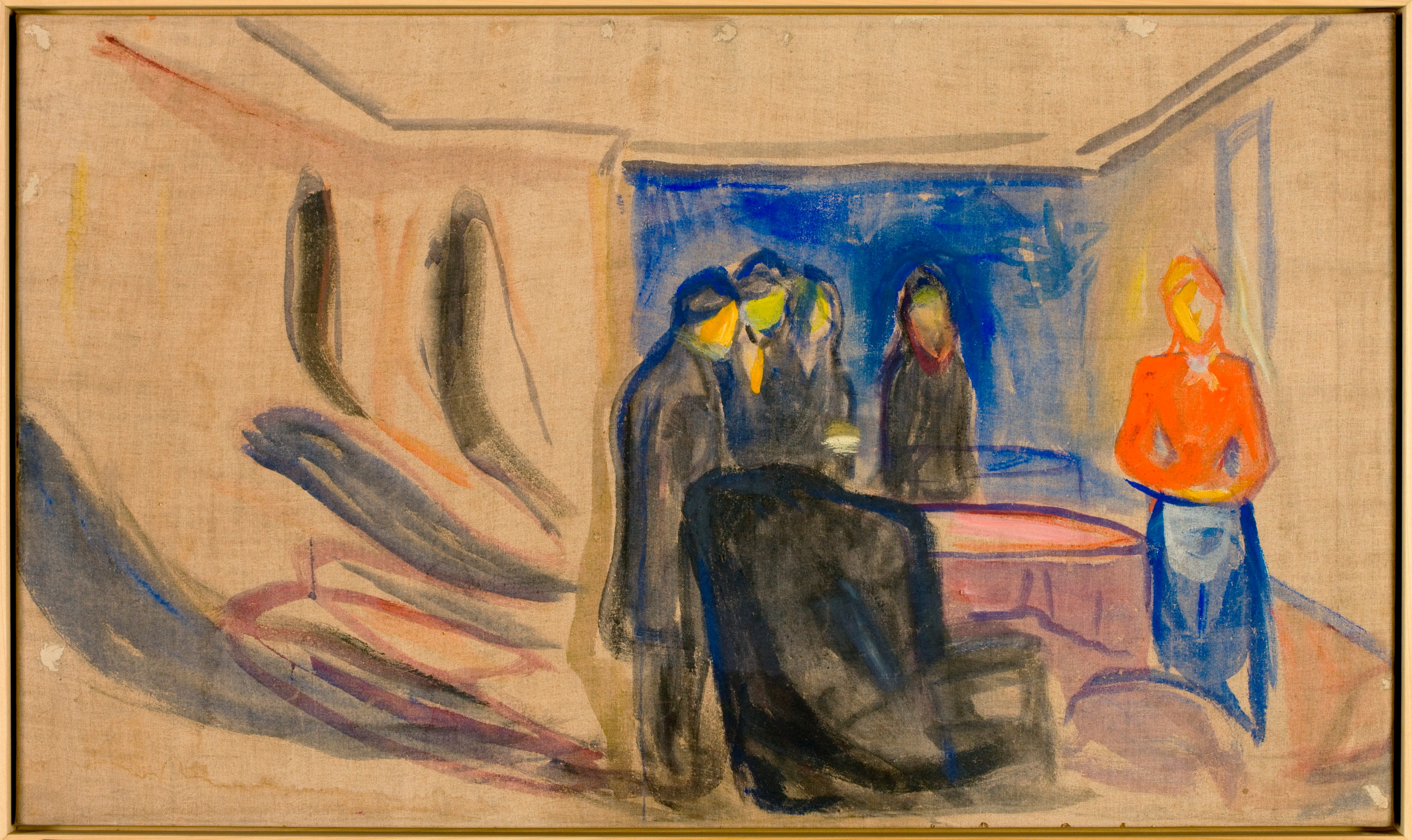
Looming shadows in Munch’s set design for Ghosts. Courtesy of the Munch Museum.
The impending doom within the bourgeois parlor was powerfully contrasted by a set design which paid special attention to the landscape outside. Ibsen’s first stage direction in the play emphasizes that “through the conservatory windows a gloomy fjord landscape can be seen, veiled by steady rain,” and the play returns to descriptions of the surrounding landscape several times.[24] Reinhardt insisted that the fjordscape should pierce and amplify the action on stage as follows: “Until now, the German theatre…has aimed at illuminating, under the blinding glare of the footlights, a clinical study of madness, while leaving everything else in the shadows. In my opinion, it is precisely the opposite that should be done.”[25] To Reinhardt, the fjordscape was no less than “the soul of the set.” This spatiotemporal dynamization deviated from the prevalent naturalistic stagings of Ghosts, as represented by Otto Brahm.
Reinhardt was familiar with Brahm’s production, having played the role of carpenter Engstrand under his direction. The younger director wanted a more symbolic approach that would merge the characters and the setting by highlighting what was hidden in the dialogue. Reinhardt’s innovation anticipated the crucial role of the Umwelt in the Kammerspielfilm, as he transformed the landscape from a geographical background into an active, symbolic component of the drama. A similar use of space can be seen in the equally intrusive and indifferent landscapes of Scherben and cityscapes of Sylvester and Der letzte Mann. In this light, it would be a mistake to confine Ibsenian drama to four walls: Ibsen’s stage directions and Munch’s set design point to larger forces at work.[26]
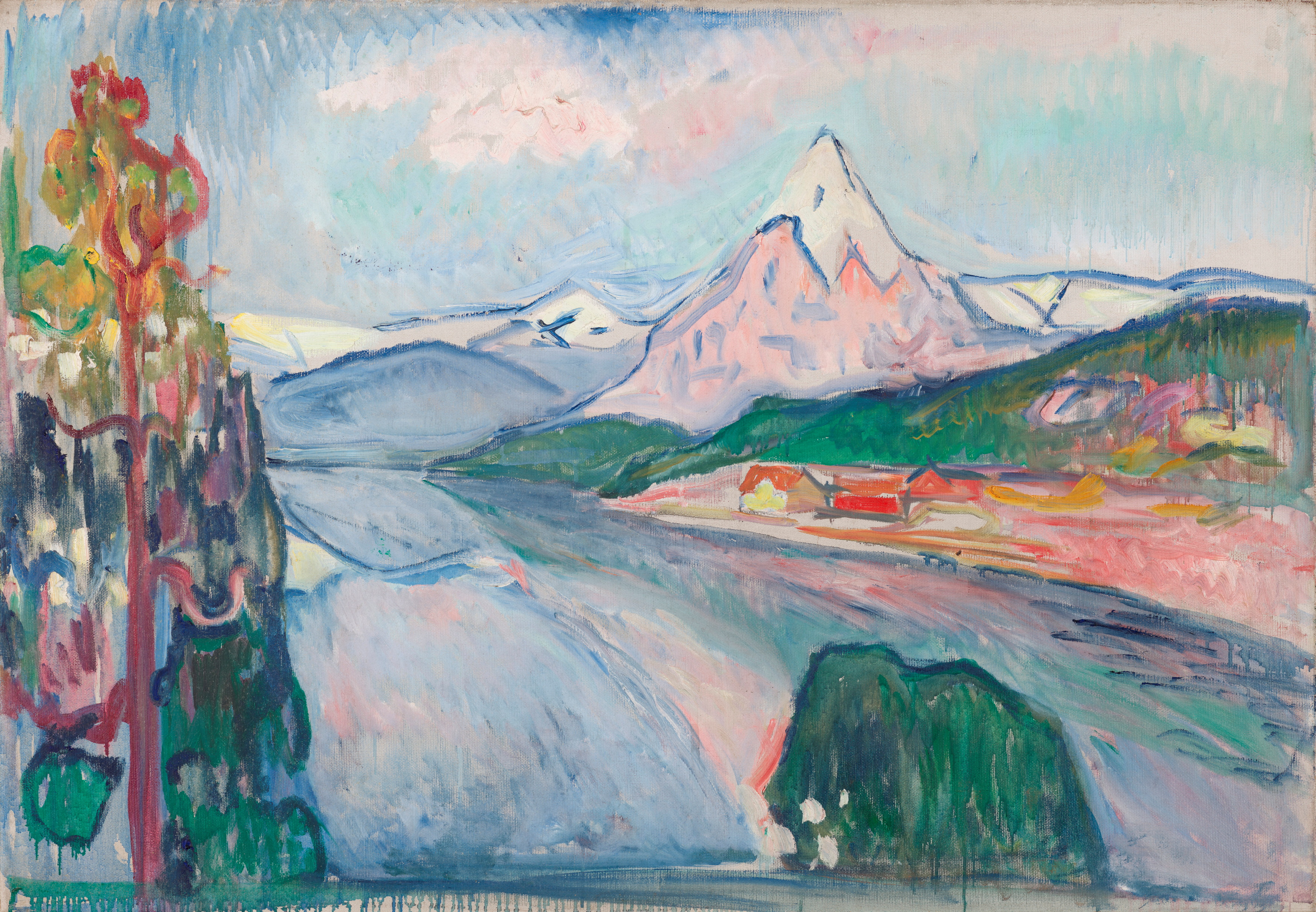
Umwelt in Munch’s set design for Ghosts. Courtesy of the Munch Museum.
November 8, 1906: Reinhard Inaugurates the Kammerspiele
The Kammerspielfilm drew its name from Reinhardt’s Kammerspiele, and theatrical and cinematic versions of the chamber play drama share a significant cast continuity. The gala premiere of Ghosts took place in Berlin on November 8, 1906. Lucie Höflich starred as the housemaid Regine, Agnes Sorma as Mrs. Alving, Alexander Moissi as Osvald, Friedrich Kayßler as Pastor Manders, and Max Reinhardt himself as carpenter Engstrand. The production was revived several times over the next fourteen years, featuring performers that would later leave their mark on Weimar cinema, among them Höflich (Nora, Das Haus der Lüge) and Werner Krauss (Scherben, Das Haus der Lüge).
Although the theater poster emphasized that “the scenography is based on sketches by Edvard Munch,” there is no solid evidence of how Munch’s paintings directly informed the production. No photographs appear to exist, and critics were more interested in the stellar cast than in the set design. Written accounts describe an unprecedented proximity between the stage and the audience. German theater critic Siegfried Jacobsohn observed that “the auditorium is no wider than the stage, no lower than the stage, and is not separated from it by an orchestra or prompter’s box. This allows for an incomparable sense of unity and intimacy.”[27] Jacobsohn compares this performance with earlier versions of Ghosts performed on German stages, which he says “unintentionally distorted the meaning of the tragedy, which is not solely the tragedy of Oswald Alving.” This observation aligns with the collective destiny implied in Munch’s sketches: Oswald faces death, the maid Regine is driven toward a brothel, Pastor Manders’ religious doctrines are undermined, and Engstrand secures the pastor’s support for his dubious seaman’s home by exploiting the situation. Jacobsohn concludes that “this new vision of Ghosts has been realized by Reinhardt’s genius so completely that even his most valuable achievements appear diminished beside it…. Every nuance serves the main design.”
Reviews suggest that Reinhardt succeeded in transposing the focus on objects and Umwelt from Munch’s set design. In Berliner Tageblatt, theater critic Fritz Engel noted that several scenes were prolonged and silent, in ways that must have drawn the audience’s attention toward the scenography and away from the dialogue. Engel described, for instance, how “in the first act, the eternal rainy day peers in through the wide window of the spacious parlor. A symbol of the joylessness of this house,” giving an impression that Reinhardt succeeded in conveying the surroundings as a symbolic force.[28]
Building on Munch’s sketches, Reinhardt gave prominence to shadows in novel ways. According to Lotte Eisner,
Max Reinhardt had realized what power there was behind that kind of shadow which fuses decoration and enigma into symbol. In his first production at the Kammerspiele in 1906—Ibsen’s Ghosts—in the scene in which the panic-stricken mother runs after her delirious son, Reinhardt got them to pass in front of a light-source, and immense shadows shot around the walls of the stage like a pack of demons.[29]
Oversized shadows are well-known harbingers of destiny in Weimar cinema. Munch and Reinhardt amplified the expressionist potential of Ibsen by focusing on psychic distress and Umwelt effects. It was in this form, and not in the competing naturalistic tradition represented by Brahm and Stanoslavsky, that Ibsen was instrumentalized for a German film aesthetic.
One of the film directors who admired and certainly learned from Reinhardt was Murnau, who provided the most iconic of these shadows with Count Orlok in Nosferatu (1922). In a mid-1920s interview with the Austrian journal Mein Film, he said that “I have a deep admiration for Max Reinhardt. He understands theater better than anyone and he is also very interested in film. What we need is a Max Reinhardt for the movies.”[30]
March 24, 1918: Oswald Adopts Osvald and Adapts Ghosts
Ibsen’s Ghosts dramatizes a number of themes, including absent fathers, illegitimacy, alcoholism, disease, prostitution, trauma, and euthanasia, which took on a renewed relevance in Germany during and after World War I. Despite the play’s theatrical success, however, it was never adapted in German film—at least not in the conventional sense of producing an announced, full-length cinematic version.[31] Nonetheless, it can be argued that Ghosts played a formative role in Richard Oswald’s infamous Aufklärungsfilm—a series of sensational silent films that dramatized taboos such as drug abuse, prostitution, and venereal disease, ostensibly in the name of public education.[32] These themes are central to Ghosts, yet the play has neither been examined as a literary predecessor of the Aufklärungsfilm nor considered for its influence on the Kammerspielfilm.
Richard Oswald was born Ornstein and adopted his professional name from the character Osvald in Ibsen’s Ghosts.[33] Thus, the O in the Richard Oswald-Film logo signals an affinity with Ibsen’s doomed painter. It is certainly difficult to see it as a coincidence that Oswald’s most controversial film, Es werde Licht! (Let There Be Light, 1917), dramatizes the fate of a painter with syphilis, just like the literary character whose name the director adopted. Es werde licht! features a chamber drama setting and led to a series of three further films. Oswald also produced a two-part adaptation of Ibsen’s Peer Gynt (1867), directed by Victor Barnowsky, which premiered in April 1919. The film opens with a sequence focusing on alcoholism, gambling, and the downfall of Peer’s father, Jon Gynt, which reads like a short Aufklärungsfilm in its own right.
However, it was with the third installment of Es werde Licht!—all of which are unfortunately lost—that Oswald appears to have truly tapped into Ibsen’s most controversial drama. According to the critic in Berliner Börsen-Courier, this gripping work initially follows the structure and inner logic of Ibsen’s Ghosts. The film depicts the devastating effects of venereal disease on a manor owner, who roughly corresponds to Ibsen’s Alving, and it portrays his wife’s relationship with another man similarly to Mrs. Alving’s relationship with pastor Manders in the play. The story then becomes more independent as it recounts the fate of the son of the manor owner, who has meanwhile passed away.[34]
This critic reads Es werde Licht! 3. Teil, starring Werner Krauss in the main role as the landowner Gorsky, as an unannounced and partial adaptation of Ghosts, suggesting where the film borrows from Ibsen’s drama—and where it departs from it. Deeper archival research would be required to map the interconnections between Ibsen’s play and Oswald’s film (series), but characters, plot lines, and themes point to deeper affinities with Ibsenian drama.
As indicated by promotional campaigns in trade journals, Oswald placed Ibsen both at the center and periphery of the Aufklärungsfilm. These films range from the traditional adaptation of Peer Gynt and partial adaptation of Ghosts to films with Ibsen-esque traits. The sado-melodrama Dida Ibsens Geschichte (The Story of Dida Ibsen, 1918), for instance, based on Margarete Böhme’s novel, circles around well-known motifs and themes from Ibsen’s social dramas: a collapsing marriage, a woman imprisoned within four walls, illness, and suicide. This makes sense considering that Böhme included Ibsen in the title of the novel. However, it is unclear whether this was meant as a direct reference or homage to the Norwegian dramatist.
Still frames from Es werde Licht! and surviving parts of Dida Ibsens Geschichte display confined spaces reminiscent of dramas by Ibsen or Strindberg. The claustrophobic setting of these films led Willy Haas to write that the Kammerspielfilm has a far more obscure and amusing origin: the German moral films from 1918 to 1920…with Richard Oswald as their master…. Even the great Murnau appreciated him, though most Berlin film critics did not take him seriously at all. One could learn a lot from Oswald, especially about the very small yet exquisite cast and the utmost restraint in interior design—perhaps only a single set. This almost became the doctrine of the Kammerspielfilm.[35]
Haas has good reason to make this claim, as he worked with Thea von Harbou and Arthur Rosen as a scriptwriter for Murnau’s Der brennende Acker (The Burning Soil, 1922). This was the second and final production of Goron-Film, which also produced Der Gang in die Nacht. Assuming Haas is correct in his claim that Oswald’s Aufklärungsfilm influenced the Kammerspielfilm, Ibsen’s Ghosts must be considered a literary predecessor linking the two.
January 21, 1921: Murnau Adapts Ibsen in “the First Kammerspielfilm”
Film historians rightly credit Lupu Pick with initiating the genre with Scherben. In German trade journals, however, it was not the earliest film discussed as an extension of the theatrical Kammerspiel. Premiering in January 1921—five months before Scherben and eleven months before Hintertreppe—Murnau’s Der Gang in die Nacht was promoted in Illustrierter Film-Kurier as a film that “marks a new era in film art. For the first time, an attempt was made to adapt the Kammerspiel to film.”[36] The program booklet further emphasizes that Der Gang in die Nacht is structured around “a powerful, gripping plot with only a few characters attuned to the finest psychological details. The unity of place and people, and the intertwining of an atmospheric mood with the inner lives of the characters, has been pursued and achieved by the most refined means of gesture and film production.” Bordwell cites this passage in his discussion of Der Gang in die Nacht and notes that “it’s interesting that the review…sees Murnau’s film as anticipating the trend. Perhaps the more rigorous concentration of time and space in the later films made critics take them for purer prototypes of the genre.”[37] Bordwell mistakenly treats this as a review rather than a promotional strategy by the production company, Goron-Film, but is likely correct about the reasons why the film has been excluded from the canon.[38] I argue here that Der Gang in die Nacht merits closer attention in the generic formation of the Kammerspielfilm and that the middle part is a partial adaptation of Ibsen’s Fruen fra Havet (The Lady from the Sea, 1888).
Der Gang in die Nacht tells the story of renowned eye doctor Eigil Börne (Olaf Fønss), who leaves his fiancée Helena (Erna Morena) and his prestigious position in the city after falling under the spell of cabaret dancer Lily (Gudrun Bruun-Steffensen). The couple relocates to a fishing village and lives in bliss until a blind painter (Conrad Veidt) arrives on the scene. Lily’s magnetic attraction to the stranger unsettles the bourgeois household, causing the plot to spiral toward the doctor’s downfall, the dancer’s death, and the stranger’s retreat into the night. Carl Mayer based Der Gang in die Nacht on “Der Sieger,” a story written by Danish scriptwriter Harriet Bloch. It is impossible to examine Mayer’s rewriting because Bloch’s manuscript is considered lost. Correspondence with Goron-Film, however, reveals that Bloch insisted on having her name removed from the credits because only her “original idea” remained.[39] This implies a substantial rewrite by Mayer, which complicates questions of authorship. These questions are further blurred by the film’s adaptation—intentional or not—of the melodramatic love triangle from The Lady from the Sea.
In Der Gang in die Nacht, the blind painter arrives the idyllic fishing village by rowboat while Lily waves goodbye to the doctor in front of their house. Lily is subsequently overwhelmed by the stranger’s sudden appearance as he passes by like a sleepwalker along the path outside their garden fence. In Mayer’s script, Lily runs toward the boatman who brought the intruder—called “the Stranger” (der Fremde), as he is in Ibsen’s play—to ask questions about him. In Murnau’s film, Lily immediately retreats behind the parlor curtains, looking around wearily as domestic harmony is transformed into disharmony. Neither the script nor the finished film offers a clear explanation of Lily’s sudden mood change—apart from the mere presence of the disabled stranger.
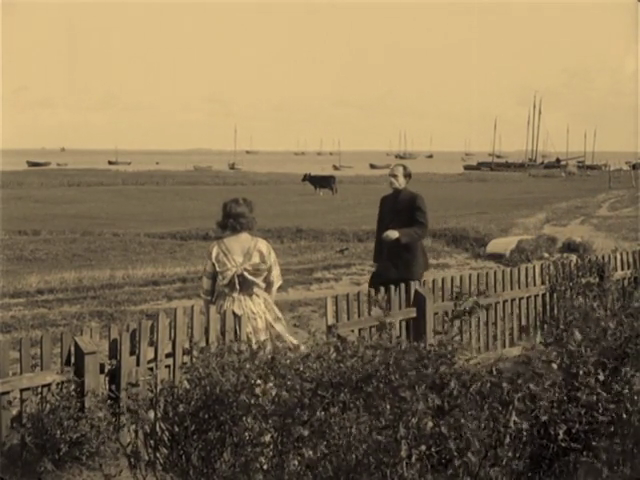
Lily meets the stranger in Der Gang in die Nacht.
According to an intertitle taken from Mayer’s script, Lily talks to the doctor about the encounter. “I met him too. He is a painter who supposedly went completely blind. He has been living alone on the outskirts of the village for years.” It is unclear whether Lily obtained this information from someone or if she already knew the intruder. In any case, the stranger’s arrival sets in motion a love triangle that mirrors The Lady from the Sea. In both texts, the female protagonists are simultaneously attracted to and frightened by the stranger’s gaze, and they initially seek solace in the arms of their doctor husbands.
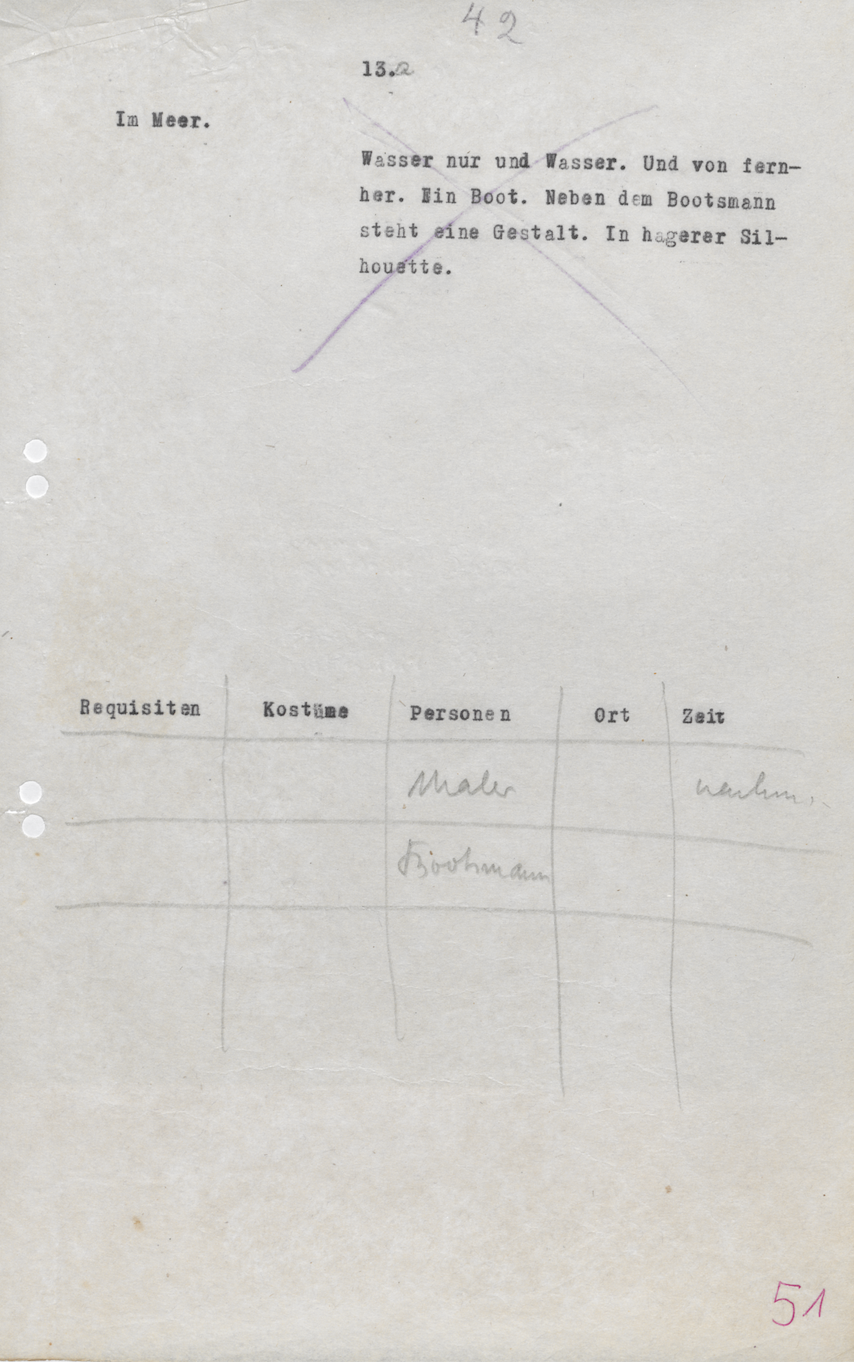
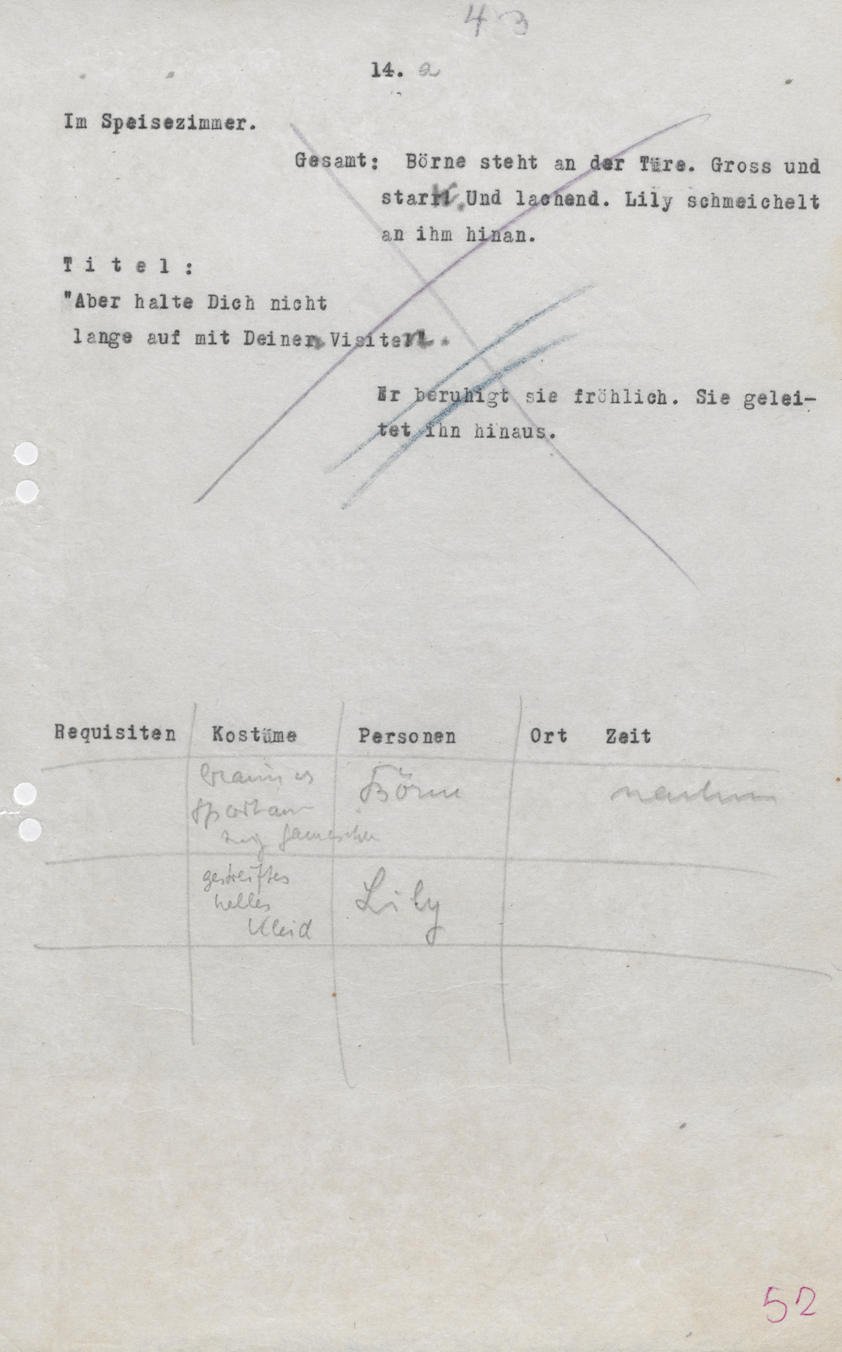
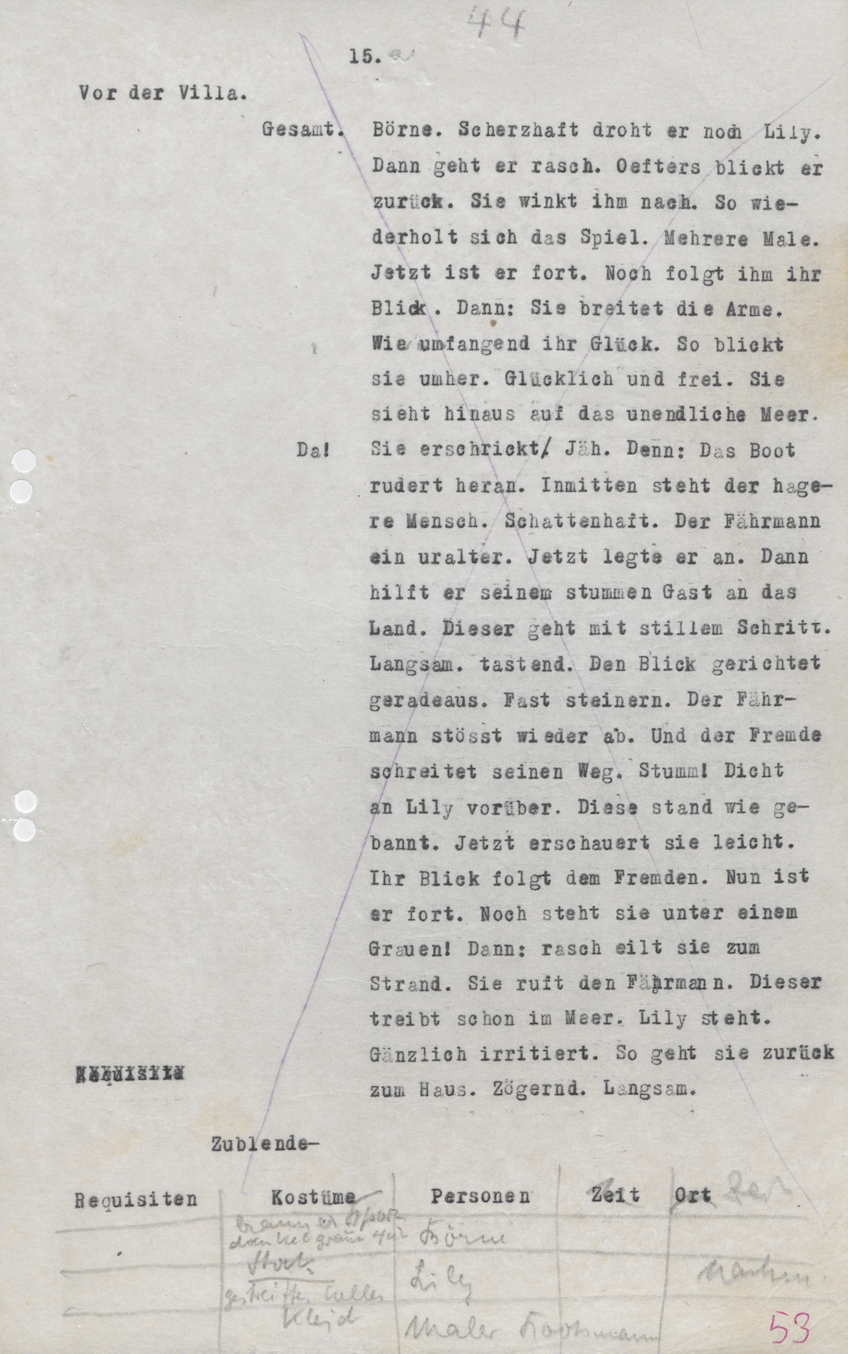
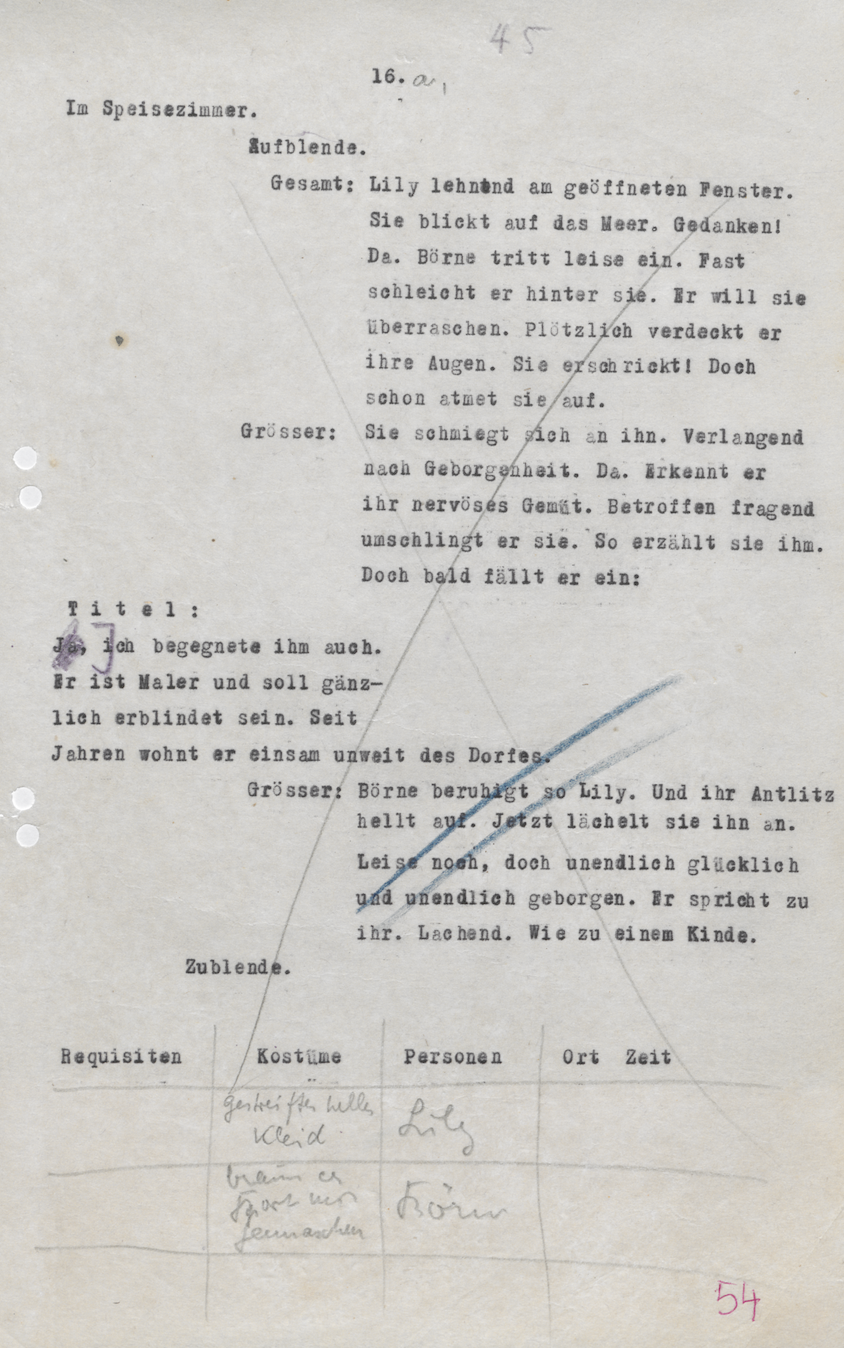
Reading Der Gang in die Nacht as a partial adaptation of The Lady from the Sea supports the possibility that the stranger is a former—perhaps even romantic—acquaintance of Lily’s, just as he is in relation to Ellida in Ibsen’s play.[41] Murnau’s initial portrayal of the stranger also mirrors Ibsen’s stage directions: in the play, the stranger arrives by boat and passes “a low trellised fence [that] separates the garden from the footpath and the fjord in the background.”[42] Likewise, the stranger passes by a fence and a garden with a seascape view in Der Gang in die Nacht.
Ibsen introduces the intruder as Ellida stands “for a while staring down into the pond. Now and then she talks to herself quietly and in broken sentences. From the left, on the footpath beyond the garden fence, comes A STRANGER dressed in travelling clothes.”[43] This stage direction emphasizes Ellida’s inwardness and the stranger’s abrupt intrusion.
ELLIDA [surprised, looks nervously at him]: Who are you? Are you looking for someone here?
STRANGER: You know I am, dear.
ELLIDA [startled]: What’s this? Why are you talking to me like that? Who are you looking for?
STRANGER: I’m looking for you, of course.
ELLIDA [jumps]: Ah–! [Stares at him, staggers backwards and lets out a stifled cry] The eyes! – The eyes!
The gaze of the stranger unsettles the heroines in both the play and the film. The Lady from the Sea is somewhat of an anomaly among Ibsen’s social dramas in that the action never takes place indoors. In Ibsen’s play, the stranger is believed to have drowned in a shipwreck. In Murnau’s film, the stranger’s background is never revealed. Reading Der Gang in die Nacht as a partial adaptation of The Lady from the Sea, despite its very different beginning and end, lends credence to the interpretation that the stranger signifies the unexpected return of a presumed-dead lover.
Ibsen’s dramas are known for extensive use of the so-called retrospective technique, in which a past full of lies is gradually revealed through dialogue in the present. Der Gang in die Nacht also contains traces of a haunting past, especially if one reads the film as a response to the trauma of World War I. As Kaes has demonstrated, Weimar era films “translate military aggression and defeat into domestic tableaux of crime and horror,” where in the early 1920s “a long absence and severe injury alluded to the war.”[44] Contemporary audiences would have been familiar with vision loss as a common symptom of shell shock, introducing the possibility of reading the blind painter as a traumatized veteran. The stranger’s arrival is framed by a striking silhouette, which is also emphasized in Mayer’s script. This never bodes well in Weimar cinema. The silhouette can be read as a hint that he is bringing war with him; the unexpected return of an allegedly deceased soldier was an uncanny and recurrent figure in the postwar era. Seen in this light, Murnau and Mayer transmute the haunted past of Ibsen’s drama into the trauma of the war experience.
This reading is reinforced by an issue of Illustrierter Film-Kurier devoted to Der Gang in die Nacht. The cover etching by occultist Albin Grau—who later served as set designer for Murnau’s Nosferatu and Pick’s Das Haus der Lüge—depicts a skeletal figure with a catatonic stare, suggesting the walking dead. Additionally, Grau’s etching and Veidt’s acting recall the latter’s role as the somnambulist Cesare in Das Cabinet des Dr. Caligari. If Kracauer is correct in arguing that the Kammerspielfilm was “emanating from Caligari,” then Der Gang in die Nacht is a missing link in his study of instinct films—one that would give Ibsenian drama a more prominent role than Kracauer recognizes in the final footnote of his chapter.[45]
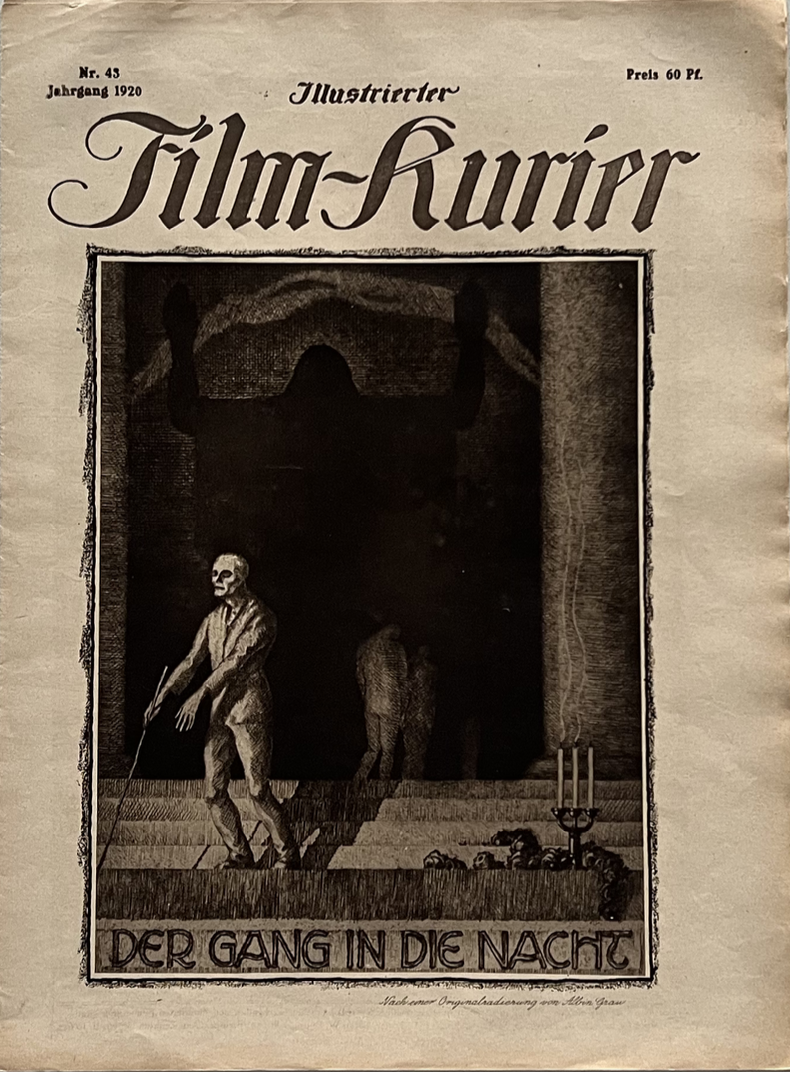
Albin Grau’s etching for Der Gang in die Nacht.
In his review of Der Gang in die Nacht, Haas observes that the film dynamizes the Umwelt in groundbreaking ways. “When the car headlights glide over the rain‑slicked asphalt of a dark metropolis, when the sea churns, or when the pale sun comes out. ‘Spectator, that also belongs to the action!’”[46] The surroundings thus function as something more than a geographical backdrop to the story. They also embed the characters—and, by extension, the audiences—in a broader social and natural environment. According to Eisner, this is the first worthy text written on Murnau. Haas also emphasizes how the minimal plot and the small number of characters reveal the film’s theatrical roots. Considering this, it is surprising that Haas sidesteps Reinhardt, noting instead that Murnau’s film “brings up the most beautiful memories of our youth: an Ibsen play staged by Brahm or a Chekhov by Stanislavsky.” Haas does not elaborate on his reference, but it is likely that the critic was referring to Brahm’s monumental Ibsen cycle at the Lessing Theater around 1910, when all of Ibsen’s social dramas, including The Lady from the Sea, were staged over a few weeks.
In an interesting reading of Mayer’s script, Patrick Vonderau distances Der Gang in die Nacht from Ibsenean drama. “In fact, Fønss’ role represents a type,” Vonderau asserts. “Even the name Eigil Börne must be considered less inspired by an Ibsenesque model than a cultural reference. It evokes associations with the North and a certain category of gloomy stories though without conjuring up anything concrete.”[47] Rather than identifying the influence of Ibsen and Strindberg on Murnau, as Elsaesser does, Vonderau draws parallels between Der Gang in die Nacht and Franz Wedekind’s Lulu dramas because of how these display “a collage of elements from naturalistic novels and a portrait of customs and manners in Paris, of melodrama and vaudeville.”[48] As Ibsen scholar Ellen Rees has explored, however, vaudeville is also a crucial component of The Lady from the Sea.[49] While I agree with Vonderau’s main point that Der Gang in die Nacht is an intermedial composite drawing on Danish talents and multiple genres, including Nordic landscape films, this otherwise enlightening reading fails to identify the partial adaptation of The Lady from the Sea and how the play’s liminal setting, architectural uncanny, and haunted past transfer to the film. In line with Munch and Reinhardt before him, Murnau amped up the expressionism of Ibsen’s drama—with the blind painter serving as a symbol of isolation and devastation, and Umwelt effects serving as a symbolic extension of the characters’ inner states.
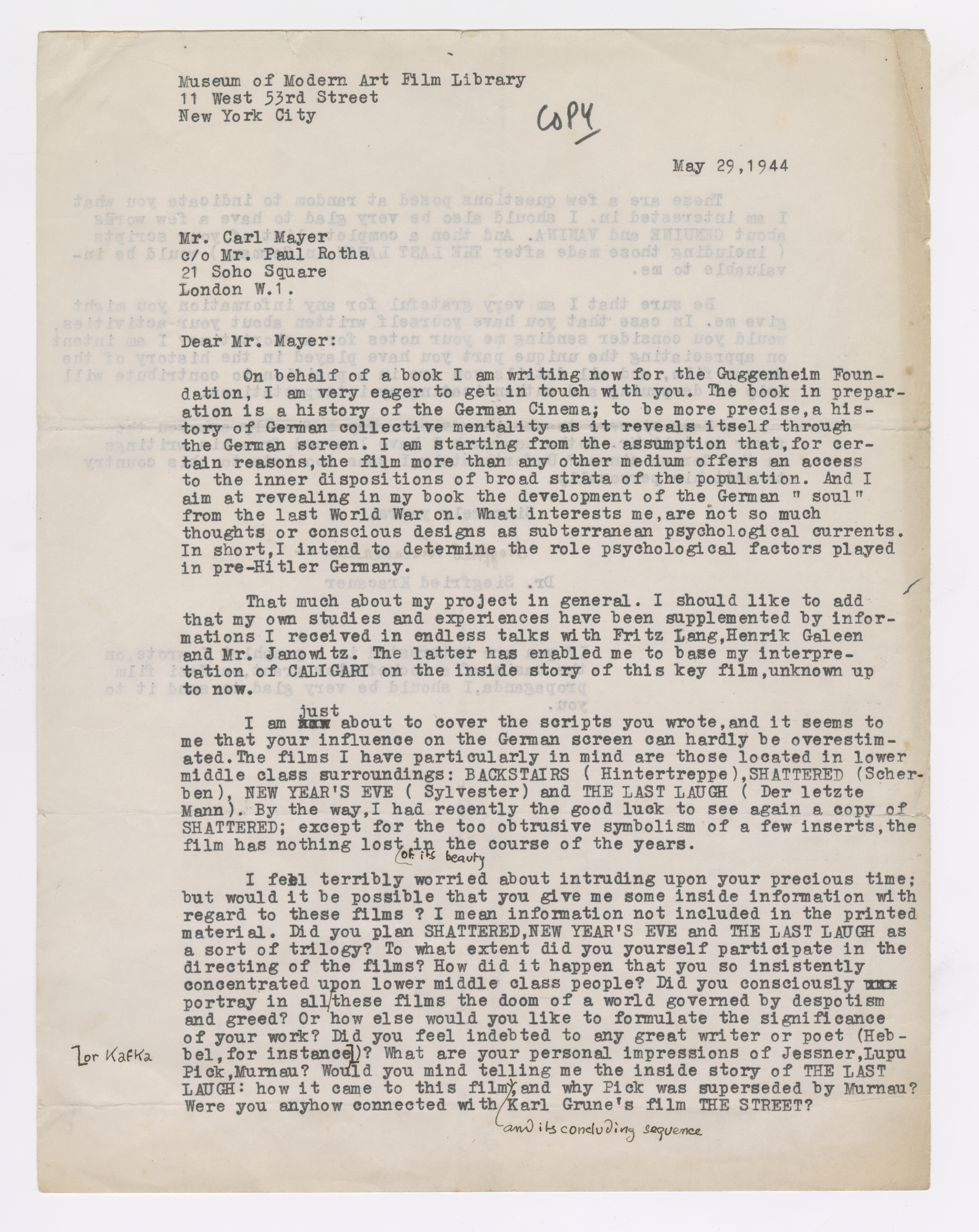
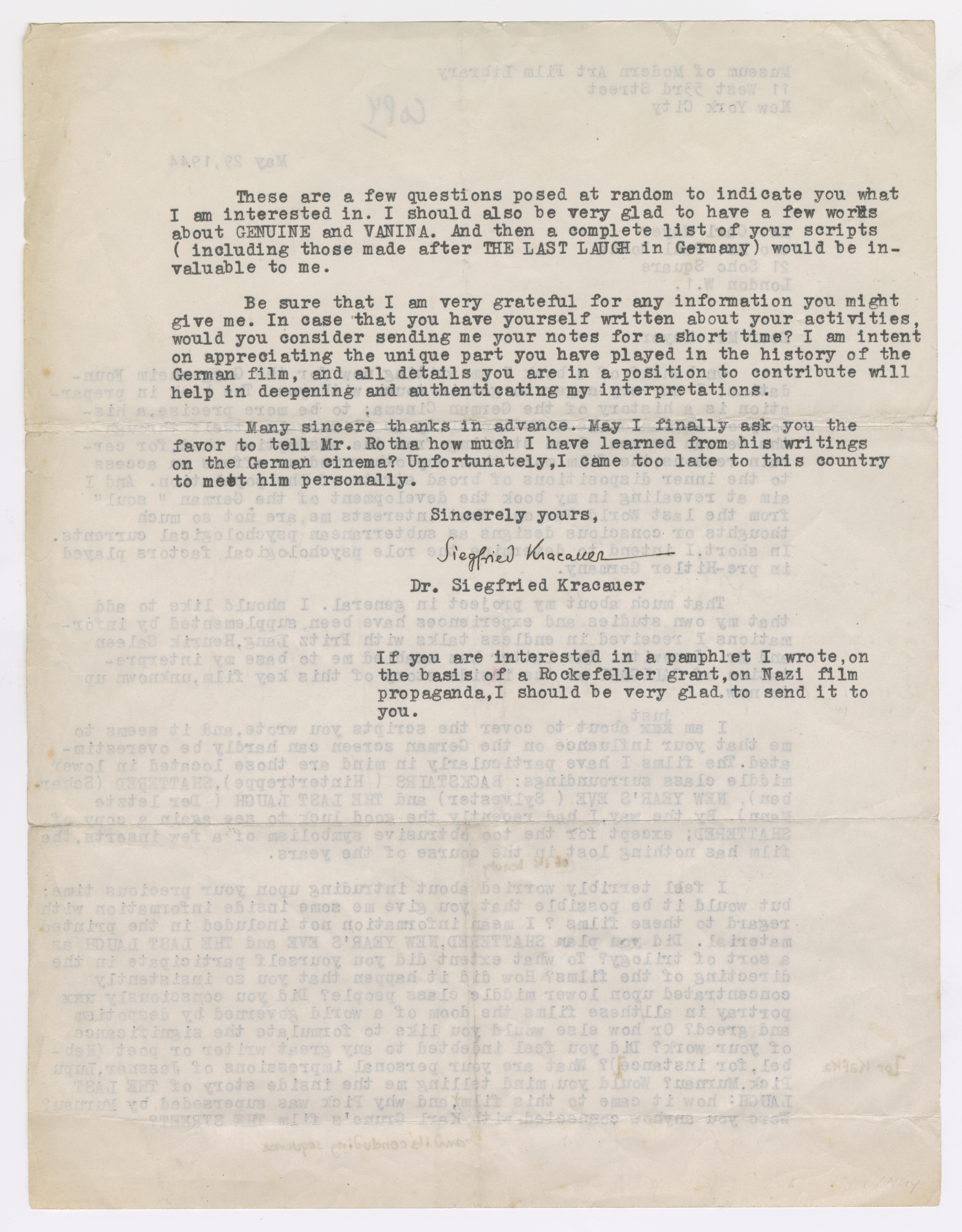
Just a month before Carl Mayer’s untimely death—broke, sick, and largely forgotten in exile in London—Kraucauer wrote him a letter inquiring about the origins of the Kammerspielfilm as part of his research for From Caligari to Hitler. “It seems to me that your influence on the German screen can hardly be overestimated. The films I have particularly in mind are those located in lower middle-class surroundings: Backstairs (Hintertreppe), Shattered (Scherben), New Year’s Eve (Sylvester), The Last Laugh (Der letzte Mann)…. Did you plan Shattered, New Year’s Eve, and The Last Laugh as a trilogy?... Did you feel indebted to any great writer or poet (Hebbel for instance)?”[50] To the last question Kracauer added Kafka in the margins. Unfortunately, we do not know whether the letter was ever answered.[51] Any influence or intended use of Ibsen on the part of Mayer remains unknown, along with the reason why his planned script for A Doll’s House was never realized.

December 11, 1921: Jessner Brings Ibsenian Drama to the Movies
Before venturing into film with Hintertreppe in 1921, Leopold Jessner had honed his craft in the Ibsen companies of Carl Heine and Gustav Lindemann. He went on to stage ten different Ibsen plays between 1905 and 1915. Recognized as one of the leading stage directors of his generation, Jessner was associated with an avant-garde that brought Expressionist sensibilities to German theater. By the end of the Wilhelmine and into the early Weimar era he had pioneered the so-called Jessner-Treppe—as seen for instance in his 1919 staging of Schiller’s Wilhelm Tell (1804) at Staatliches Schauspielhaus in Berlin. This innovative use of stairs dynamized the stage and symbolized either inner psychology, social divisions, or both.
In an article titled “Die Treppe — eine neue Dimension” (The Staircase – a New Dimension, 1922), Jessner argued that stairs should function as more than just an “integrated part of the decoration,” but rather “as an independent architectural construction.”[53] He traced this idea back to his 1915 staging of Ibsen’s Peer Gynt. Given Jessner’s fascination with Ibsen and with staircases, it is surprising that he did not stage John Gabriel Borkman (1896) until 1928, which explicitly uses stairs to depict psychological and class divisions.
Jessner regarded Ibsen as “the dramatic apostle of the twentieth century.”[54] According to him, Ibsenian drama underlies no less than the modern theater practices.
Because of his unique literary style, theater people must acknowledge Ibsen as a theatrical arbiter and co-founder of today’s performance practices. Regardless of how far-reaching and intricate the psychological development of his characters may be, he emphasized—almost mathematically—a Wesenslinie for the first time.[55]
Jessner highlights the concept of a Wesenslinie or consistent inner trajectory: characters act according to the inner logic of the drama as they develop through it. This type of psychologically coherent character development was particularly well-suited to the compulsory dramaturgy of the Kammerspielfilm, among them Jessner’s own.
With Hintertreppe, the German director transposed the Jessner-Treppe to the screen. Jessner also limited the setting and the cast. The story centers on an unnamed maid, her lover, and a postman, and takes place in the courtyard of a Berlin apartment building. Other characters appear only briefly and largely serve as markers of class difference. The film is tightly governed by necessity, and its controlled dramaturgy and precise character development mirror the disciplined logic that Jessner saw in Ibsen.
Hintertreppe revolves around a love triangle in which the lover suddenly reappears after having been considered dead due to an injury (a shadow at the window marks his return). Jessner argued that cultural expressions had to respond to World War I and wrote that “theater history, like any historical process, develops through reactions. A truth lasts at most fifteen years, says Henrik Ibsen, and then makes way for a new one. With the decisive event of the war, theater has once again reached a turning point.”[56] Given Jessner’s conviction that Ibsen was foundational to modern theater, it is reasonable to assume that he felt it was urgent to reconcile Ibsenian drama with the demands of postwar Germany.
Jessner’s film is not a literal adaptation of an Ibsen play, but it shares key elements with several of them: a small cast, confined space, short timeframe, and violent or deadly outcome. It also recalls motifs, such as the stairs in John Gabriel Borkman and the return of a presumed-dead lover in The Lady from the Sea. If Hintertreppe is a Kammerspielfilm in the tradition of an Ibsen drama, it exemplifies the kind of adaptation that film scholar Audun Engelstad has discussed as adaptation by reimagination: Ibsen is recognizably present, yet the reimagining is total because there is no clearly identifiable source text.[57] When viewed alongside other films of the genre, a pattern emerges in which Hintertreppe—like Der Gang in die Nacht before it and Das Haus der Lüge after it—recasts the haunted past of Ibsenian drama into the trauma of World War I.
The weight of a past permeated by lies reverberated in postwar Germany, where deceit and disease lurked beneath the façade of bourgeois and working-class families. “If we wanted to write a social history of mistrust in Germany, then above all the Weimar Republic would draw attention to itself. Fraud and expectations of being defrauded became epidemic in it,” writes Peter Sloterdijk. “In those years, it proved to be an omnipresent risk of existence that from behind all solid illusions, the untenable and chaotic emerged.”[58] The tension between illusion and reality is a recurring theme in Ibsen’s works. As Mark Sandberg has explored, Ibsen’s social dramas relentlessly undermine domestic ideals as their settings invariably transform from homely to unhomely, familiar to uncanny.[59] This trajectory is also a hallmark of the Kammerspielfilm—they all begin in apparent domestic bliss, only to unveil darker forces lurking beneath the surface. Seen in this light, Ibsen’s social dramas gained renewed relevance in everyday life in the Weimar Republic; the Kammerspielfilm imbued Ibsenian drama with postwar realities, dramatizing how psychological and societal pressures destroy ordinary men and women, like the maid, lover, and postman in Hintertreppe.
January 3, 1924: Pick Quotes Munch in Sylvester
In Lupu Pick’s Sylvester, the weight of the past comes tumbling down on a fateful New Year’s Eve. Upon its premiere, only three days after the real-life celebrations in 1924, the critic in Kinematograph noted that “this moving picture is a play of prerequisites. Just like a good play, it shows only the final phase of a development that the spectator must piece together from the action.”[60] The critic went on to argue that “Karl [sic] Mayer—who intended this manuscript to be poetic like Scherben—is a belated successor to naturalism.” With its Ibsenian dramaturgy, Sylvester writes itself into a dramatic tradition initiated by Ibsen through his retrospective technique and theatrical naturalism.
Once again, an exaggerated shadow, marking the arrival of the man’s mother, functions as a harbinger of impending doom, echoing Munch’s set design and the shattered glass in Scherben. As Noah Isenberg points out, “any hopes of an intimate late-night supper together—the camera lingers on a small table bedecked with two place settings—are quickly dashed with an emotion-laden disruption posed by the arrival of the Husband’s mother, first captured in haunting profile, vaguely reminiscent of the vampire’s shadow climbing the staircase in F.W. Murnau’s Nosferatu (1922), outside the frost-covered kitchen window.”[61] The question is not whether the domestic harmony will fall apart, but what the shared destiny of the three unnamed characters—the man, the woman, and the mother—consists of.
For the set design, Pick turned to expressionist painter Klaus Richter, who had previously worked on Stellan Rye’s Der Student von Prag. Richter’s sketches bear a striking resemblance to Munch’s. First, Richter also included a clock with a pendulum ticking toward the man’s death (and a new year). Regarding Sylvester, Kracauer notes that here “the motif of the clock acquires its full meaning…. As with twelve strokes it marks the beginning of the new year, the camera turns from it to the corpse of the café-owner, thus forcing upon us our simultaneous existence in the outer and inner world, the temps espace and the temps durée.”[62] For audiences of Reinhardt’s Ghosts, the clock would have had a similar effect, juxtaposing Osvald’s final hour with linear time and the cyclical time of nature.
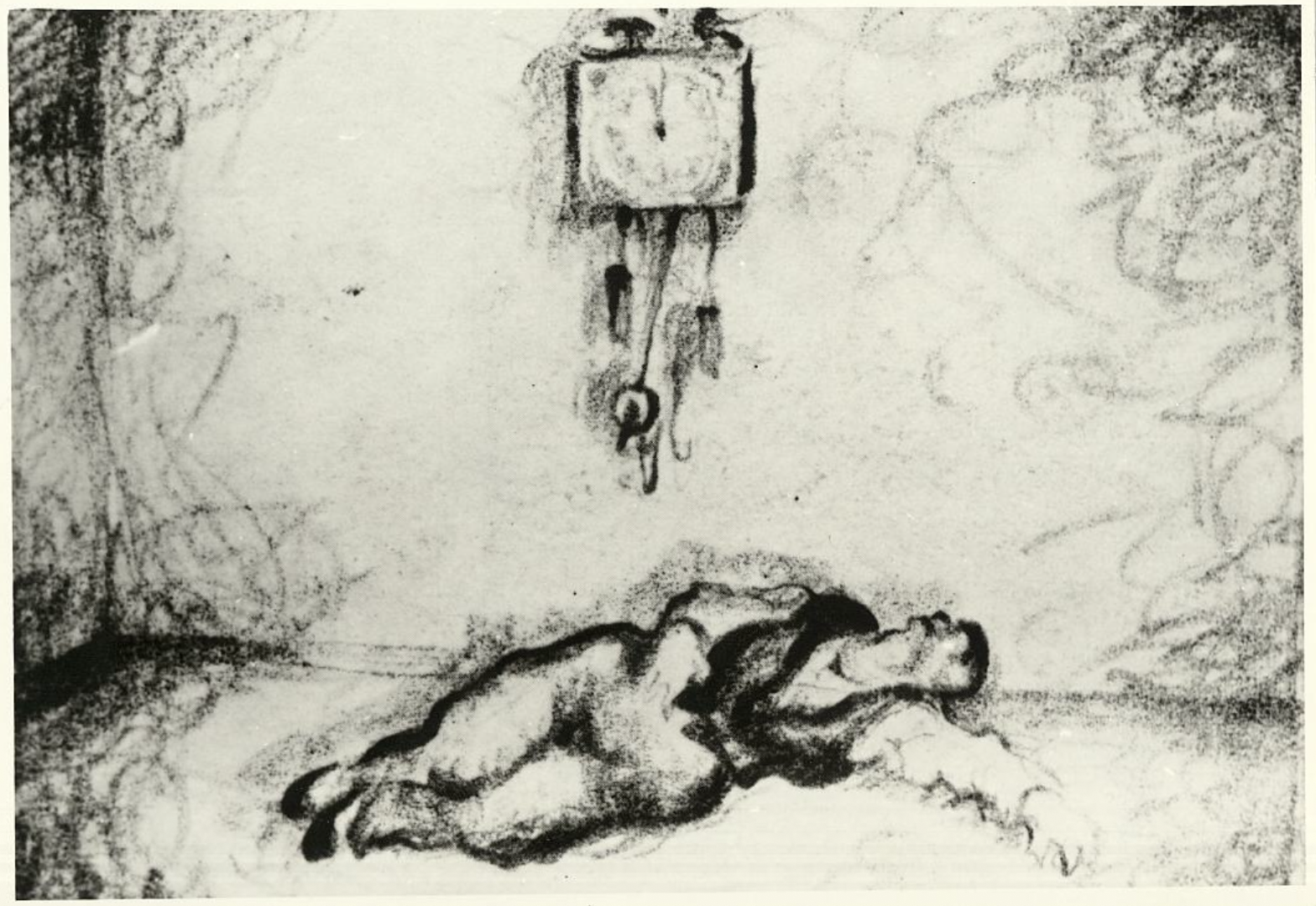
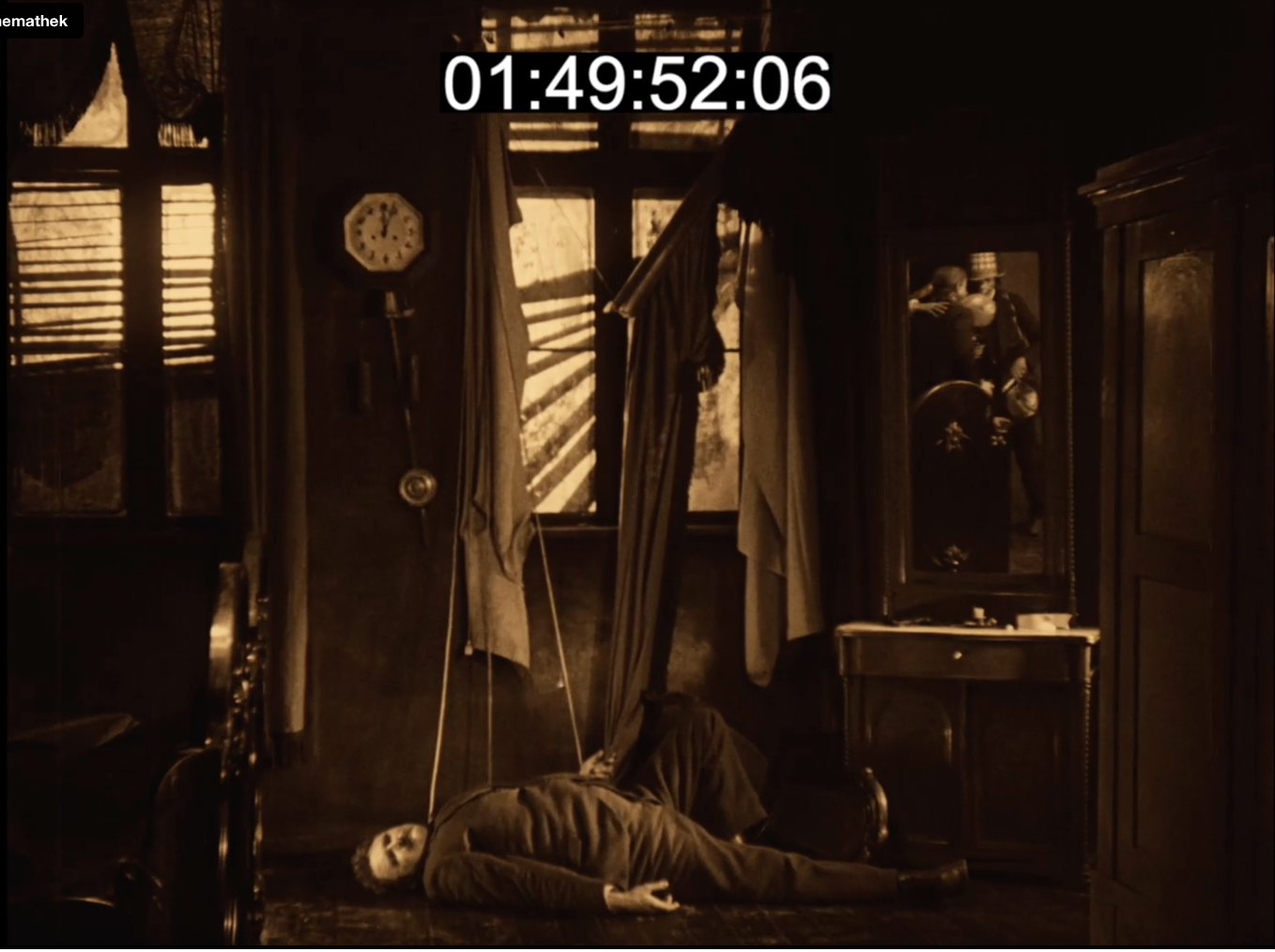
The clock has ticked toward death in Sylvester. Richter’s sketch left. Courtesy of Bundesarchiv.[63]
Secondly, Richter provided a sketch proposing the Umwelt of the story: a busy cityscape with masses indifferent to the tragedy unfolding inside. Pick elaborated on this idea by inserting scenes with a seascape and a graveyard that further accentuate the symbolic contrast between the action and the surroundings. Regarding Mayer’s script, Pick commented that “the composition of this moving picture seems to me novel because it encloses the action within a limited framework, giving a major role to the Umwelt without involving it in the action proper, which would be banal. The Umwelt must constitute the base and symphonic background of a particular destiny and thus become the emblem of a principal idea.”[64]
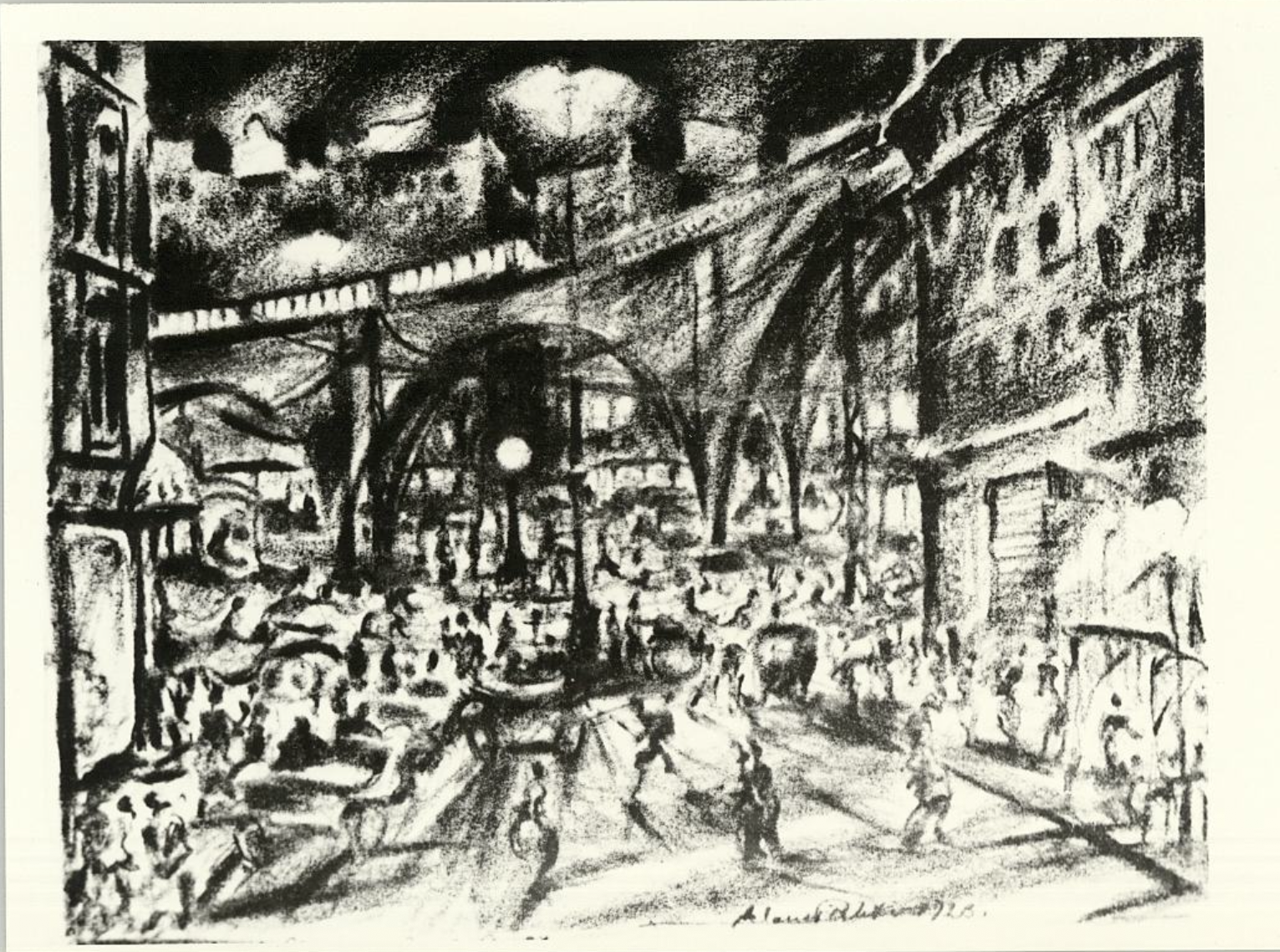
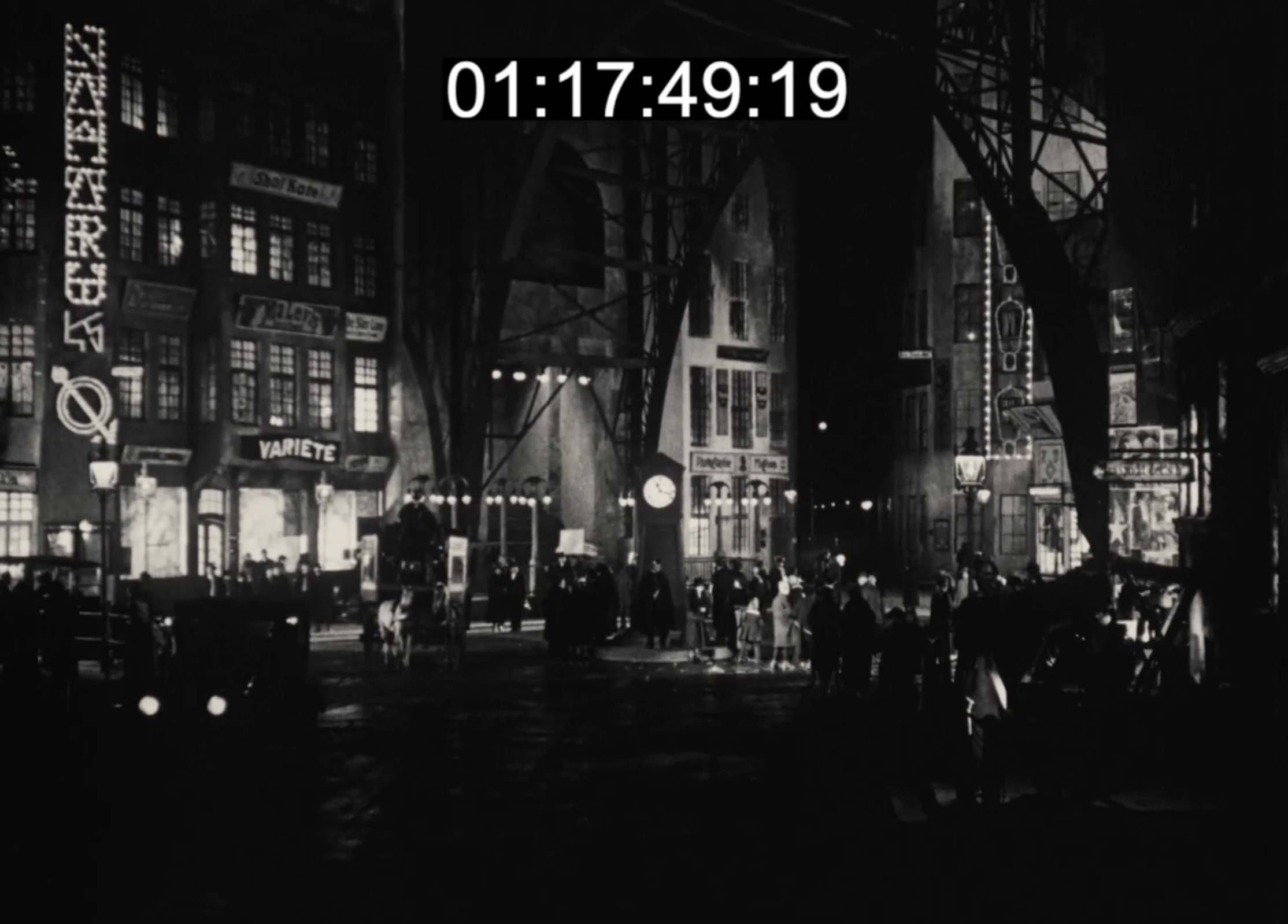
The contrasting cityscape in Sylvester. Richter’s sketch left. Courtesy of Bundesarchiv.
Whether or not Richter’s set design should be seen as an intentional imitation of Munch’s, the film carries further similarities worth considering. The portraits on the wall—one showing the man with his wife and one showing the man with his mother—mirrors Munch’s portraits of the ancestors in Ghosts. Both symbolize the weight of a past closing in on the characters in the present. Crushed between two suffocating demands of love, the man chooses suicide rather than choosing between them. Even the powerful sketch in which Mrs. Alving embraces her son Osvald bears a striking similarity to the film. Kracauer also identifies this scene as significant in his analysis, stressing that “the man breaks down, and while the mother caresses him as if he were a child, he rests his head helplessly on her bosom. This gesture, followed (and corroborated) by the suicide of the man, betrays his intense desire to return to the maternal womb.”[65] In Ghosts, the last we see of Osvald is this intense scene in which he pleads with his mother to euthanize him. In Sylvester, the disconcerting embrace between mother and son is the last we see of the man before his suicide. On its way to that violent outcome, Sylvester displays a mastery of Ibsenian dramaturgy and Munchian imagery.
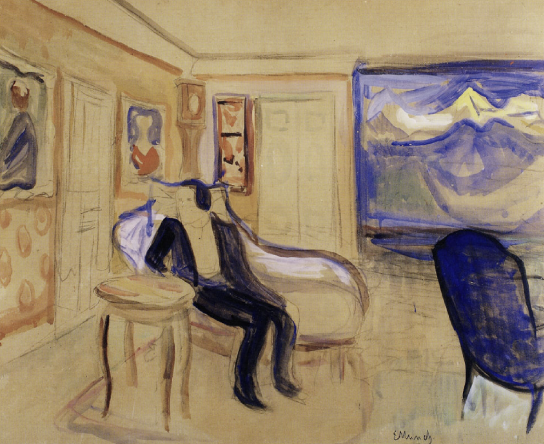
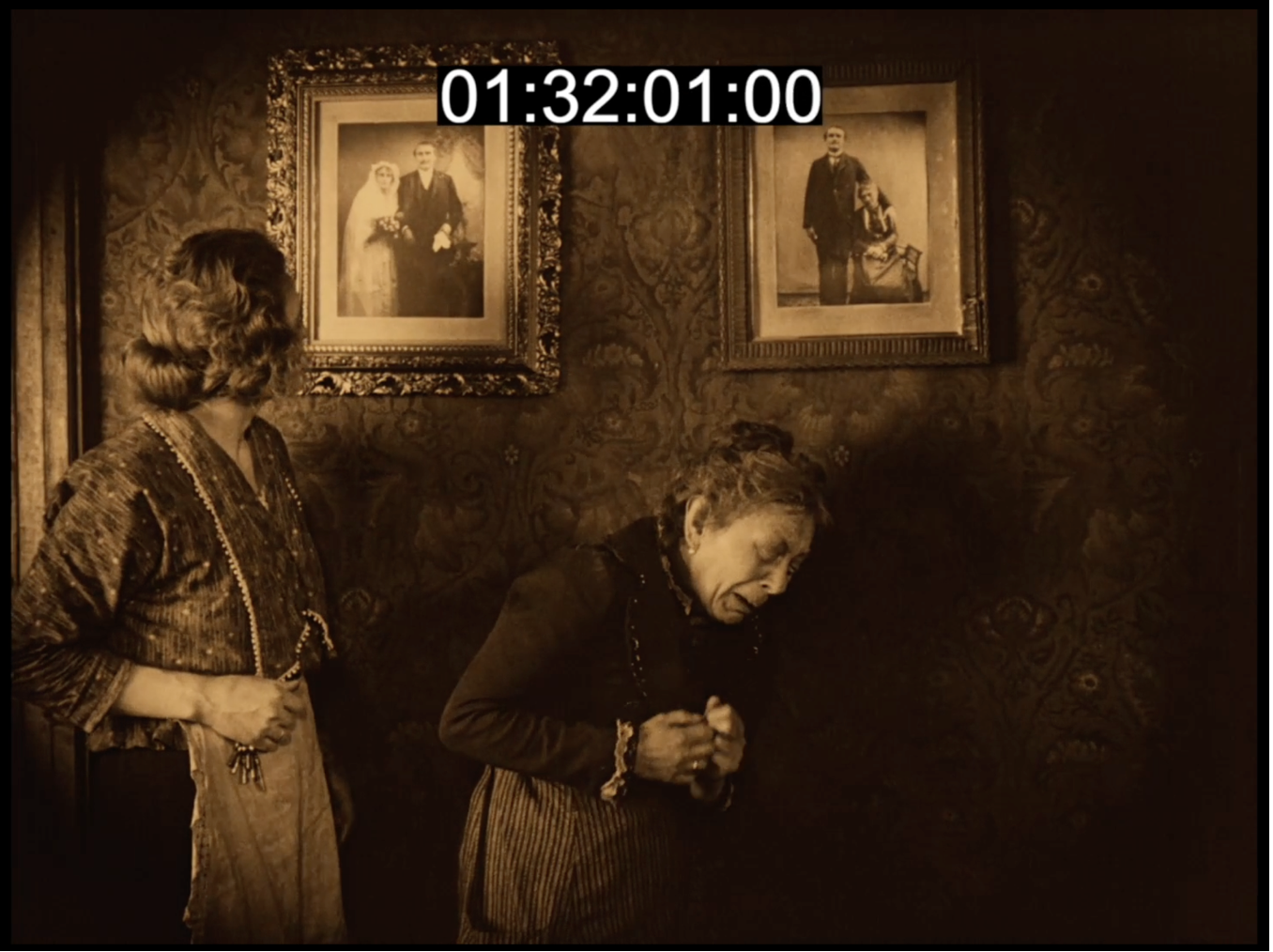
Family portraits carry the weight of the past in Ghosts and Sylvester.
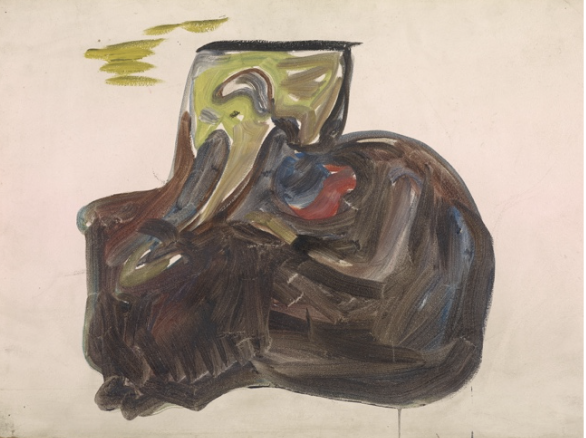
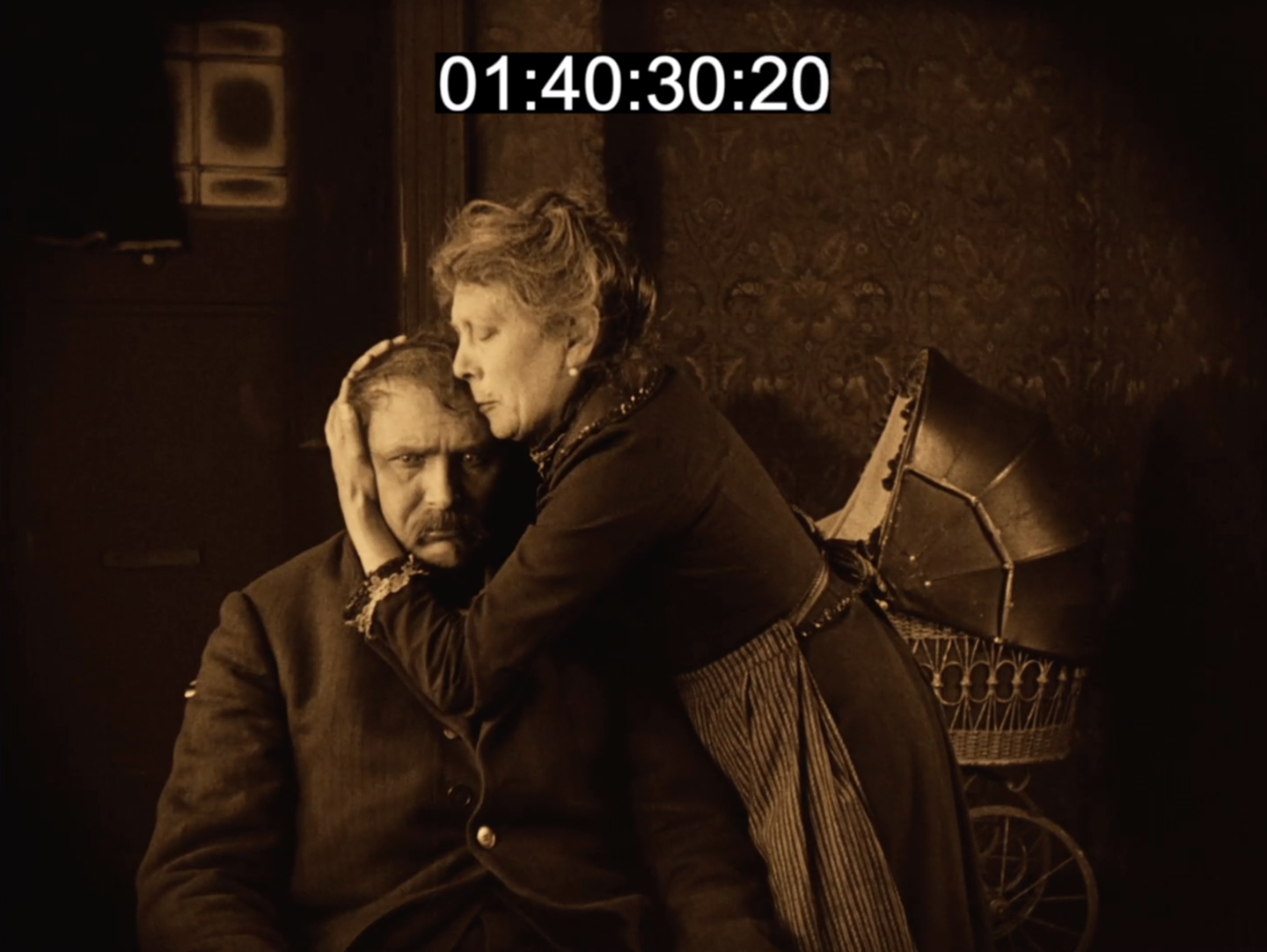
The mother’s embrace of her son in Ghosts and Sylvester.
October 15, 1923: SkandinoFilm Goes Bankrupt
It is not known whether the critical success of the Kammerspielfilm played a role in the emergence of a new production company which had the ambition of adapting Ibsen’s dramas. However, the paper trail left behind by the short-lived SkandinoFilm suggests a deliberate strategy aimed at positioning itself as a company specializing in adaptations of Scandinavian literature. “We have acquired the rights to Henrik Ibsen’s John Gabriel Borkman and Stützen der Gesellschaft,” read a full page ad in Kinematograph on July 22, 1923. “Preparations for John Gabriel Borkman have begun. In the main role: Werner Krauss.” Casting Krauss in the titular role signaled continuity with Scherben and the choice of John Gabriel Borkman gave the filmmakers an opportunity to build on Jessner’s use of stairs in Hintertreppe. The motif of the railway as a symbol of capitalist progress and local alienation, as depicted in Scherben, also establishes the basis for the conflict in Ibsen’s The Pillars of Society.[66]
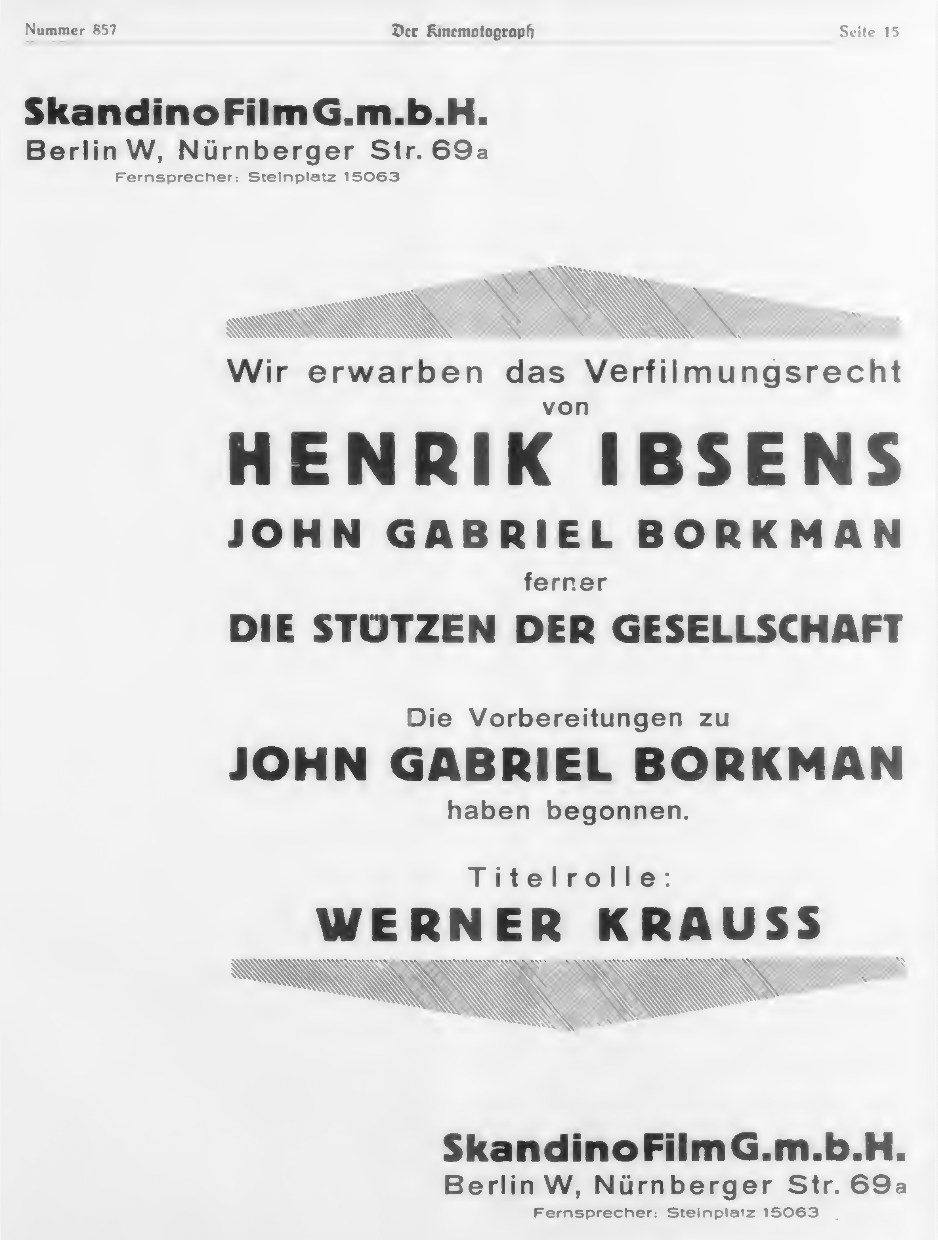
SkandinoFilm promoting two Ibsen adaptations.
SkandinoFilm was founded by businessman Holger Boldemann together with director Martin Hartwig, who had played Johannes Rosmer in a 1904 production of Ibsen’s Rosmersholm (1886) by Gustav Lindemann’s Das Ibsen-Theater aus Berlin (an ensemble which also included Leopold Jessner in its ranks). SkandinoFilm turned to the seasoned Ibsen actor Ernst Legal to write the screenplay for John Gabriel Borkman, with assistance from director and scriptwriter Alfred Halm. The two were formally commissioned in a letter dated July 25, 1923, which indicates that Hartwig had already seen a brief synopsis. “We ask you to ensure that we receive a detailed draft by Monday 30th this month at the latest. We also ask you to complete the manuscript in cooperation with Mr. A. Halm by mid‑August this year.”[67] The optimistic, hurried tone of this letter is undercut by a later notice that the production company declares bankruptcy in October due to a lack of funds. Whether a full manuscript was ever completed is unknown, though it is plausible, given the early deadline imposed on the writers—two months before the planned Ibsen adaptations were abruptly halted.
Had it not been for the bankruptcy of SkandinoFilm, five of Ibsen’s twelve social dramas would have been adapted during the first half of the Weimar Republic: The Pilllars of Society, A Doll’s House, The Wild Duck, Hedda Gabler, and John Gabriel Borkman. One could also include the partial adaptations of Ghosts in Es werde Licht! 3. Teil and The Lady from the Sea in Der Gang in die Nacht. Other Ibsen plays were also adapted into films. The 1919 adaptation of Peer Gynt has already been mentioned and Fritz Lang incorporated materials from the same play in M (1931). Notably, Hans Hinrich’s adaptation of Ibsen’s poem “Terje Vigen” (1862), titled Das Meer ruft (The Sea Calls 1933), was the last pacifist anti-war film produced during the Weimar era. Although SkandinoFilm’s Ibsen projects and Mayer’s contracted script for A Doll’s House never came to fruition, examining Ibsen’s legacy within these unproduced “shadow cinemas” is important for understanding his broader impact on Weimar film culture.
January 22, 1926: Pick Falls Out with Mayer and Adapts The Wild Duck
It is a curious episode in the history of the Kammerspielfilm that it was initially Lupu Pick who was commissioned to direct Der letzte Mann. He was also supposed to play the hotel porter, which would have been his second appearance in a Kammerspielfilm after portraying the intruder in Scherben. According to film historian Carl Vincent, Pick and Mayer disagreed so sharply over Der letzte Mann that Pick either quit or was dismissed from the project.
[Their collaboration] lasted until a dispute over the portrayal of the porter in Der letzte Mann separated them. This film was planned as the third part of a trilogy that started with Scherben and continued with Sylvester…. The conflict caused Murnau to take over directing the film, and he gave the role of the porter to [Emil] Jannings.[68]
One can only speculate whether Der letzte Mann would have achieved international renown under Pick’s direction. As I argue elsewhere in an anthology on Ibsen and silent cinema, what is certain is that Pick completed his Kammerspielfilm trilogy by adapting The Wild Duck.
In this analysis, I argue that Das Haus der Lüge critiques bourgeois ideology and warns against the illusions inherent in the photographic medium. In doing so, the film comments on the visual turn in the Weimar Republic and the rivalry between the German film industry and Hollywood. Das Haus der Lüge highlights the role of the young girl Hedwig (Mary Johnson) and how her alleged father, Hjalmar Ekdal (Werner Krauss), has been kept in the dark about her true paternity until a Heimkehrer, Gregers Werle (Walter Janssen), arrives on the scene. Gregers’ father, the wealthy merchant Jan Werle (Albert Steinrück), is in fact Hedwig’s biological father. The film also adds a new ending to Ibsen’s play: after the illegitimate daughter commits suicide, Hjalmar and Gina Ekdal (Lucie Höflich) continue on together. Resonating strongly with the postwar context, these themes align with Sloterdijk’s observations about widespread fraud and shattered illusions.
Das Haus der Lüge displays a high degree of fidelity to The Wild Duck. Yet it effects a radical shift in dramaturgy by presenting the play’s burning idealist, Gregers Werle, as physically disabled and nearly sedated in the opening sequence. An intertitle reveals that the young Werle has returned to his hometown after “a long absence,” which, given the production context, suggests that Das Haus der Lüge introduces yet another traumatized veteran into the Kammerspielfilm. An iris close-up of his boots reveals that one leg needs extra support; a cut to a shot from behind reveals a limp.
This reading is supported by another significant departure from Ibsen’s play at the end of the film, when Gregers Werle—who, by disclosing Hedwig’s parentage, triggers her suicide—leaves the Ekdal household following the tragedy. As he descends the staircase, he is cast in a double shadow—two dark silhouettes that evoke Murnau’s Nosferatu and can reasonably be interpreted as another allegory for the devastation of war. The parallel is likely deliberate, as Albin Grau designed both films.
Caught between the penetrating gaze of a traumatized veteran and the protective illusions of a bourgeois household, Hedwig succeeds only in her death to compel her stepfather to embrace her vision of unconditional love. This is depicted through Hedwig’s relationship with a duck that Hjalmar’s father gives her as a gift at the beginning of the film. The girl refuses to fasten a ring inscribed with “I belong to Hedwig” to the animal. The ring lingers conspicuously in an extreme close-up when she receives it as a birthday gift and again after her death, before the added coda. When Hedwig receives the ring, an intertitle explains that her understanding of love precludes dispossessing anyone of their freedom. “Isn’t that like putting a shackle around her foot? She shouldn’t feel that she is no longer a free bird.” Equally telling is her attempt to attract the attention of her presumed father by drawing the shape of a heart in the salt on the table, an appeal that is rebuffed. The film’s new ending sees a repetition of this symbol when Hjalmar, Gina, and Dr. Relling (Eduard von Winterstein) set out to lay a heart-shaped wreath marked with the initial “H” on Hedwig’s grave on the anniversary of her death. This act echoes and inverts the child’s earlier gestures.[69]
A laconic intertitle introduces the new ending, stating that “life went on…only little Hedwig was no longer there…,” giving viewers at least two likely interpretations. On the one hand, it suggests the possibility of moving forward after the exposure of deceptions and beyond bourgeois family structures. On the other hand, it echoes the unlikely, ironic ending of Der letzte Mann, in which the hotel porter’s misfortunes abruptly reverse when he inherits a fortune. Following the latter reading, Das Haus der Lüge reveals a conscious, self-reflexive relationship with Mayer’s Kammerspielfilm, which goes beyond displacing Ibsen’s haunted past into the trauma of the war experience. The film also quotes Scherben in two pivotal scenes. First, the close-up of Gregers Werle’s boots mirrors those of the intruder in Scherben. Secondly, his appearance on Hedwig’s birthday, when the truth about her parentage is about to be revealed, coincides with a glass frame slipping from her hands and shattering.
If the less restricted use of space has kept Der Gang in die Nacht from being considered a Kammerspielfilm, it is the intertitles in Das Haus der Lüge that deviate from the genre’s strict conventions. A critic in Filmtechnik complained that “many intertitles could have been spared, as these reiterations emphasize the intellectual elements of the play and testify to an exaggerated worship of authority that is irrelevant for the film,” yet still considered it “one of the most artful film creations in recent years.”[70] Pick’s deviation from Scherben and Sylvester on this point may reflect a change in popular demand and commercial expectations. By the mid-1920s, the novelty of omitting intertitles might have worn off. Moreover, images from the existing copy of the film reveal that the adaptation was made for international distribution, as evidenced by the ring showing engravings in both Swedish and English.
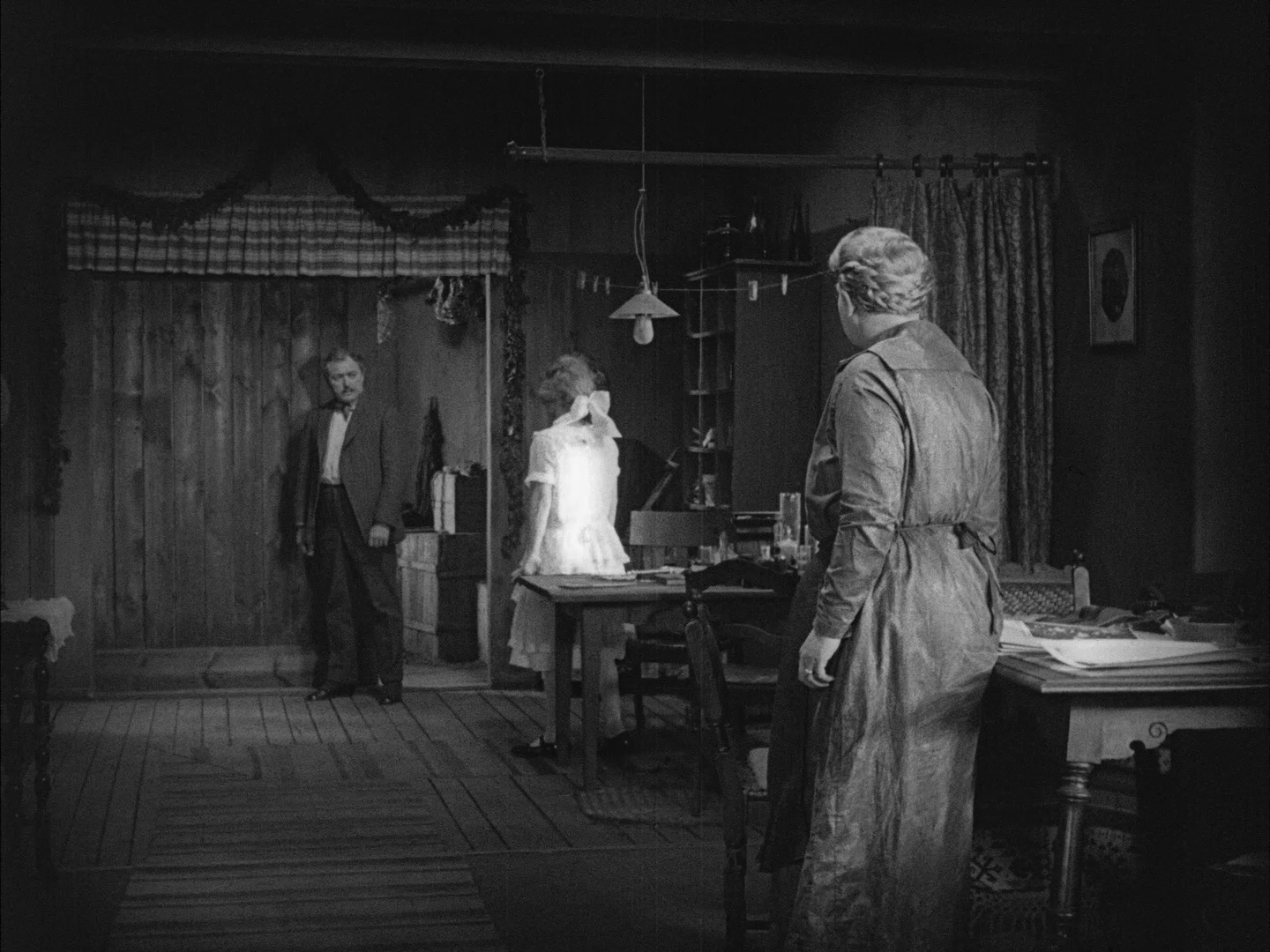
A static tableau as the parentage is revealed in Das Haus der Lüge.
The casting of Das Haus der Lüge harks back to Reinhardt’s Kammerspiele, where Werner Krauss, Lucie Höflich, Eduard von Winterstein, and Albert Steinrück all performed in his legendary stagings of Ghosts. Not only does Das Haus der Lüge complete Pick’s Kammerspielfilm trilogy, it also reads as a swansong of the genre. The film comes full circle by returning to Ibsen’s original drama, with the same emphasis on objects, shadows, and collective destiny pioneered by Munch’s set design and Reinhardt’s stage production. In this regard, the German Kammerspielfilm reached its logical end.
Epilogue
The Ibsenian lineage of the Kammerspielfilm has arguably been underappreciated because it only becomes apparent when examining the interventions of Munch and Reinhardt. From this angle, the Kammerspielfilm is better understood as an intermedial adaptation of the expressionist Kammerspiel tradition rather than the naturalist Ibsen tradition.
The afterlife of the Kammerspielfilm can be seen in the psychological dramas of Ingmar Bergman and R. W. Fassbinder in the 1960s and 70s. It is hardly accidental that both drew on Ibsen’s works in their films and staged his plays in Swedish and German theaters. While further film historical investigations on Ibsen and the Kammerspielfilm may be fruitful, a more complete account of the genre’s formation, intermediality, and legacy requires situating it within a broader range of cultural, social, and political networks, among them Strindberg, Hauptmann, and other prominent writers and directors of chamber play dramas.
Scholars often lament the small number of film adaptations of Ibsen compared to those based on Shakespeare. Some even single out Victor Sjöström’s classic silent film Terje Vigen (1917) as the only successful adaptation of his works. It is telling that Ibsen biographer Robert Ferguson dismisses the impact of cinematic Ibsen adaptations, claiming they have not “left any particular mark on the film histories of their countries of origin.”[71] Asbjørn Aarseth argues that the “narrow room” of Ibsen’s dramas poses a formal obstacle to film adaptation, while others claim that the retrospective technique is anathema to cinema.[72] Further research on Ibsen and the Kammerspielfilm may invert this perspective: the main contribution of Ibsenian drama to film history may lie precisely in how its claustrophobic setting and haunted past were transposed into the formal and thematic conventions of the Kammerspielfilm, via crucial intermediaries like Munch and Reinhardt.
Thor Holt is associate professor at the Centre for Ibsen Studies, University of Oslo.
Thank you to Mark Sandberg for sharing his expertise on both Ibsen and silent cinema through some extremely helpful comments. Archival research was made possible by generous grants from the Norwegian-German Willy Brandt Foundation, the Andor Birkeland and his wife Halina’s Scholarship, the Mayor Edvard Christie’s Scholarship, and a Fulbright Visiting Scholar Award. The author would also like to thank the following people and institutions for invaluable assistance with archival materials: Philip Schilf at Bundesarchiv, Gunnar Gutschmidt, Christiane Grün, Anke Vetter, and Anke Hahn at Deutsche Kinemathek, Florian Bielefeld at Akademie der Künste, and Halvor Bjørngård at the Munch Museum.
References
[1] Hanns Heinz Ewers, “Vom Kinema,” in Kein Tag ohne Kino: Schriftsteller über den Stummfilm, edited by Fritz Güttinger (Frankfurt am Main: Deutsches Filmmuseum, 1984), 22. All translations are my own unless otherwise noted.
[2] The generic formation of the Kammerspielfilm is, of course, much more complex than this article accounts for. For a discussion of the genre’s genealogy, including an excellent reading of Hintertreppe, see Ellen Risholm, “Formations of the Chamber: A Reading of Backstairs,” ch. 3 in Peripheral Visions: The Hidden Stages of Weimar Cinema, edited by Kenneth Scott Calhoon (Detroit: Wayne State University Press, 2001), 121–43.
[3] As argued by Sally Ledger, “Stanislavsky’s subsequent development of the more naturalistic character method of acting was an imperative demanded by Ibsen’s spearheading of naturalist theater in the late nineteenth century.” Sally Ledger, “Naturalism: ‘Dirt and Horror: Pure and Simple',” in Adventures of Realism, edited by Matthew Beaumont (Oxford: Blackwell, 2007), 78.
[4] Per Thomas Andersen, Norsk litteraturhistorie (Oslo: Universitetsforlaget, 2001), 244.
[5] See Kristin Thompson and David Bordwell, “The Ten Best Films of…1923,” Observations on Film Art, December 29, 2013, davidbordwell.net/blog/2013/12/.
[6] Ibsen’s “social dramas” is a term often used to distinguish his last twelve dramas, written between 1877 and 1899, from his earlier works, including his youth dramas and historical dramas written between 1850 to 1873.
[7] Anton Kaes, “Scherben,” in Le Giornate Del Cinema Muto 32, edited by Catherine A. Surowiec (Pordenone: Le Giornate del Cinema Muto, 2013), 152.
[8] Kracauer also noted the “rigidly composed action” in Mayer’s films. Siegfried Kracauer, From Caligari to Hitler: A Psychological History of the German Film (Princeton: Princeton University Press, 1947), 97, 104.
[9] Kracauer, From Caligari to Hitler, 106.
[10] See Willy Haas, Die Literarische Welt: Lebenserinnerungen (Frankfurt am Main: Fischer Taschenbuch Verlag, 1957), 102. Nora, starring Olga Tschechowa as Nora and Fritz Kortner as Dr. Rank, is considered lost.
[11] Thomas Elsaesser, Weimar Cinema and After: Germany’s Historical Imaginary (New York: Routledge, 2000), 228.
[12] Anton Kaes, Shell Shock Cinema: Weimar Culture and the Wounds of War (Princeton: Princeton University Press, 2009), 118.
[13] Lotte H. Eisner, Murnau (London: Secker & Warburg, [1964] 1973), 15.
[14] Jürgen Kasten, Carl Mayer: Filmpoet: Ein Drehbuchautor schreibt Filmgeschichte (Berlin: Vistas, 1994), 28.
[15] Felix Hollaender, undated letter to Edvard Munch, 1906. In the holdings of the Munch Museum.
[16] Arthur Kahane, letter to Edvard Munch, July 11, 1906. In the holdings of the Munch Museum.
[17] Cited in Joan Templeton, Ibsen’s Munch: A Painter’s Vision of a Playwright (Seattle: University of Washington Press, 2008), 48.
[18] Cited in Templeton, Munch’s Ibsen, 49.
[19] Cited in Templeton, Munch’s Ibsen, 40.
[20] Haas, Die literarische Welt, 126.
[21] For another excellent discussion of Munch and Reinhardt, as well as on this point, see Scott T. Cummings, “‘A Strange Boulder in the Whirlpool of Theater’: Edvard Munch, Max Reinhardt, and Ghosts,” in Edvard Munch: Psyche, Symbol, and Expression, edited by Jeffery Howe (Massachusetts: University of Chicago Press, 2001), 120–21.
[22] Cited in Templeton, Munch’s Ibsen, 50–51.
[23] Cited in Templeton, Munch’s Ibsen, 50.
[24] Henrik Ibsen, Ghosts, in A Doll’s House and Other Plays, edited by Tore Rem (London: Penguin, 2016), 193.
[25] Cited in Templeton, Munch’s Ibsen, 48.
[26] This would position Ibsen’s drama and Munch’s sketches as intermediaries between what Ellen Risholm discusses as the “petrified sphere of the Kammerspiel theater” and the “more sophisticated examination of space” in the Kammerspielfilm. Risholm, “Formations of the Chamber,” 129, 140.
[27] Siegfried Jacobsohn, Max Reinhardt (Berlin: Erich Reiß, 1910), n.p. It is also worth mentioning that a year later, in 1907, Strindberg’s Intima Teatern opened in Stockholm, using many of these same spatial principles. “In 1907 and 1908 Strindberg wrote five plays for performance at his own Intimate Theatre, Intima Teatern, in Stockholm: Thunder in the Air, After the Fire, The Ghost Sonata, The Pelican, and The Black Glove. All were published in inexpensive editions by Ljus Publishing House and numbered as ‘Chamber Plays,’ Op. 1 to 5. This represents the first occurrence in Swedish of the term kammarspel to designate a play but, as Strindberg himself acknowledged, he was inspired by Max Reinhardt’s Kammerspiele…. Strindberg also sent Reinhardt German translations of these works soon after they were written, and the latter’s expressionist performances of these plays would make some of them part of the theatrical repertoire, at least in Germany and Scandinavia, where the terms kammarspel and Kammerspiel have come to designate a genre of plays with a restricted cast of characters, an emphasis on mood rather than plot, and intimate settings, often in interiors that suggest psychological space, as well as a social setting.” Lynn R. Wilkinson, “The Chamber Plays,” ch. 9 in The Cambridge Companion to August Strindberg, edited by Michael Robinson (Cambridge: Cambridge University Press, 2009), 107.
[28] Fritz Engel, “Kammerspiele des Deutschen Theaters: ‘Die Gespenster’ von Henrik Ibsen,” Berliner Tageblatt 35, no. 573, November 10, 1906.
[29] Eisner, Murnau, 130.
[30] F. W. Murnau, “Film und Filmleute von Heute und Morgen.” Mein Film, no. 42, 1926, 6.
[31] An Austrian adaptation of Ghosts was made in 1918, directed by Otto Kreisler.
[32] An even more explicit cautionary tale against syphilis is Eugène Brieux’s Les Avariés (1901), which was translated in 1911 and performed in 1913 under the title Damaged Goods. This drama was the subject of numerous stagings and adaptations concerning sexual hygiene on both sides of the Atlantic. Oswald’s Aufklärungsfilm was thus part of a wider international movement.
[33] John T. Soister, Conrad Veidt on Screen: A Comprehensive Illustrated Filmography (Jefferson, NC: McFarland & Company, 2009), 41.
[34] Cited in Kinematograph, “Urteile der Tagespresse über den Kulturfilm ‘Es werde Licht’ III. Teil,” no. 587, April 3, 1918.
[35] Haas, Die Literarische Welt, 102.
[36] Illustrierter Film-Kurier, no. 43, 1920, Der Gang in die Nacht, 6.
[37] David Bordwell, “Murnau before Nosferatu,” Observations on Film Art, November 6, 2016. https://www.davidbordwell.net/blog/2016/11/06/murnau-before-nosferatu/
[38] A contemporary review notes how the film was promoted by the production company as the first attempt at a Kammerspielfilm. Kinematograph, review of Der Gang in die Nacht, no. 278, January 30, 1921.
[39] Patrick Vonderau, “‘Two Figures Stand High up on a Cliff. Shadowy.’ On Carl Mayer’s Screenplay ‘Der Gang in die Nacht’,” in Carl Mayer, Scenar[t]ist. Ein Script von ihm war schon ein Film, edited by Michael Omasta, Brigitte Mayr, and Christian Cargnelli (Wien: Synema, 2003), 112.
[40] Carl Mayer, Der Gang in die Nacht (Berlin: Goron-Film, 1920), in the holdings of Deutsche Kinemathek, Personenarchiv, Friedrich Wilhelm Murnau Archiv, 4.4-199224_05.
[41] Ibsen’s play also features a painter named Ballestad and an ailing, aspiring sculptor named Lyngstrand who seeks help from doctor Wangel. Der Gang in die Nacht can be said to merge these three characters into one.
[42] Henrik Ibsen, The Lady from the Sea, in Hedda Gabler and Other Plays, edited by Tore Rem (London: Penguin, 2019), 235.
[43] Ibsen, The Lady from the Sea, 242.
[44] Kaes, Shell Shock Cinema, 3, 118.
[45] Kracauer, From Caligari to Hitler, 96.
[46] Willy Haas, review of Der Gang in the Nacht, Film-Kurier, December 14, 1920. For a discussion of Umwelt in the Kammerspielfilm, see Eisner, The Haunted Screen, 179–97.
[47] Vonderau, “On Carl Mayer’s Screenplay ‘Der Gang in die Nacht’,” 116.
[48] Vonderau, “On Carl Mayer’s Screenplay ‘Der Gang in die Nacht’,” 117.
[49] Ellen Rees, “Ibsen’s Happy Endings; or, The Vaudeville Origins of Modern Drama,” Nineteenth Century Studies 36 (2024): 111–25.
[50] Thank you to Ellen Risholm for making me aware of this letter.
[51] In an obituary on his friend Carl Mayer, the British filmmaker and critic Paul Rotha confirms that “a few weeks before his death he received a letter from Dr. Siegfried Kracauer.” Paul Rotha, “Carl Mayer – An Appreciation,” in A Tribute to Carl Mayer: Memorial Programme (London: Scala Theatre, 1947), 7.
[52] Siegfried Kracauer, letter to Carl Mayer, May 29, 1944, in the holdings of Deutsche Kinemathek, Personenarchiv, Carl Mayer Archiv, 198110_1.
[53] Leopold Jessner, Schriften: Theater der zwanziger Jahre (Berlin: Henschelverlag, 1979), 154.
[54] Jessner, Schriften, 218, 225.
[55] Jessner, Schriften, 234.
[56] Jessner, Schriften, 124.
[57] Audun Engelstad, “Rewriting Ibsen for the Big Screen,” Journal of Scandinavian Cinema 11, no. 2 (2021): 179.
[58] Peter Sloterdijk, Critique of Cynical Reason, translated by Michael Eldred (Minneapolis: University of Minnesota Press), 483.
[59] Mark Sandberg, Ibsen’s Houses: Architectural Metaphors and the Modern Uncanny (Cambridge: Cambridge University Press, 2015).
[60] Kinematograph, review of Sylvester, no. 882, January 13, 1924, 13.
[61] Noah Isenberg, program essay on Sylvester, San Francisco Silent Film Festival, 2022.
[62] Kracauer, From Caligari to Hitler, 103.
[63] Richter’s set design for Sylvester is in the holdings of Bundesarchiv, BArch, FilmSg 1, Bild-16422-01.
[64] Cited in Eisner, The Haunted Screen, 186. The quote is from the preface to the published version of the manuscript.
[65] Kracauer, From Caligari to Hitler, 99.
[66] Kaes, “Scherben,” 152.
[67] SkandinoFilm, letter to Ernst Legal, July 25, 1923, in the holdings of Akademie der Künste, Ernst Legal Archiv, 2884.
[68] Carl Vincent, “Histoire de l’Art Cinématographique” (Bruxelles: Editions du Trident, 1939), 149.
[69] Thanks to Yifan Zhang for a good discussion of this repetition in a seminar on Das Haus der Lüge.
[70] A.K. [pseud.]. “Rotstift und Ratschlag,” review of Das Haus der Lüge, Filmtechnik, March 3, 1926, p. 101.
[71] Robert Ferguson. “Ibsen on Film.” Scandinavian Review 94, no. 2 (2006): 48.
[72] Asbjørn Aarseth, “Drama in the Narrow Room: Teichoscopy as a Constitutional Difficulty in the Ibsen Film,” in Ibsen on Screen, edited by Jan Erik Holst and Astrid Sæther (Oslo: Norsk filminstitutt, 2000), 38–51.